

The cost of getting ready to trade and the amount of funding proposed for a launch are related, but they need not be equal. A business may also need cash to operate while sales build.
Show startup uses, the resulting opening cash and the operating cash path as connected parts of one forecast.
Start with the uses of cash.
A cost list is easier to review when each item has a purpose. In the restaurant example, startup uses total $183,500: $157,000 in assets, $22,000 in expensed setup and $4,500 in initial stock. These values are saved model inputs, not a universal restaurant budget.
| Use | Saved amount | Includes |
|---|---|---|
| Assets | $157,000 | Refurbishment, kitchen equipment, furniture and POS/signage |
| Expensed setup | $22,000 | Pre-opening occupancy, training/tests and preparation |
| Initial stock | $4,500 | Opening ingredients |
| Total startup uses | $183,500 | Before normal operation |
Unknown required costs deserve their own treatment. A missing deposit or unquoted site repair does not become zero simply because the list otherwise looks complete.
Keep opening cash visible.
The example proposes $250,000 of equity at month 0: $80,000 from the founder and $170,000 from an external investor. After $183,500 of startup uses, modeled opening cash is $66,500. That remainder supports the operating buffer and unallocated contingency in this scenario.
Both contributions are proposed. The forecast does not establish that either amount is available. An investor request is also different from a modeled unfunded gap: a funded scenario can show no gap while still depending on an investment being raised.
Follow the buffer through the sales ramp.
Opening cash is not a separate annual expense. It is money available to absorb the timing of receipts and payments. The restaurant’s sales ramp, staffing, occupancy and purchasing assumptions determine what happens to it next.
The forecast’s minimum cash is $27,659.62. It stays positive under the saved funded scenario, but that does not establish viability or guarantee that a real launch can use the same budget. A slower ramp or more site work needs a new calculated scenario.
Check the inputs before making the ask.
- Obtain actual site and equipment quotes.
- Confirm deposits and the timing of pre-opening payments.
- Review staffing coverage against the operating hours.
- Confirm which funding is available and which is still proposed.
- Test the monthly cash path under weaker sales.
Keep an explicit contingency decision. In this example, do not add another contingency charge without first deciding how it relates to the cash already left after startup uses.
See the funding request and uses of funds in the complete plan ↗
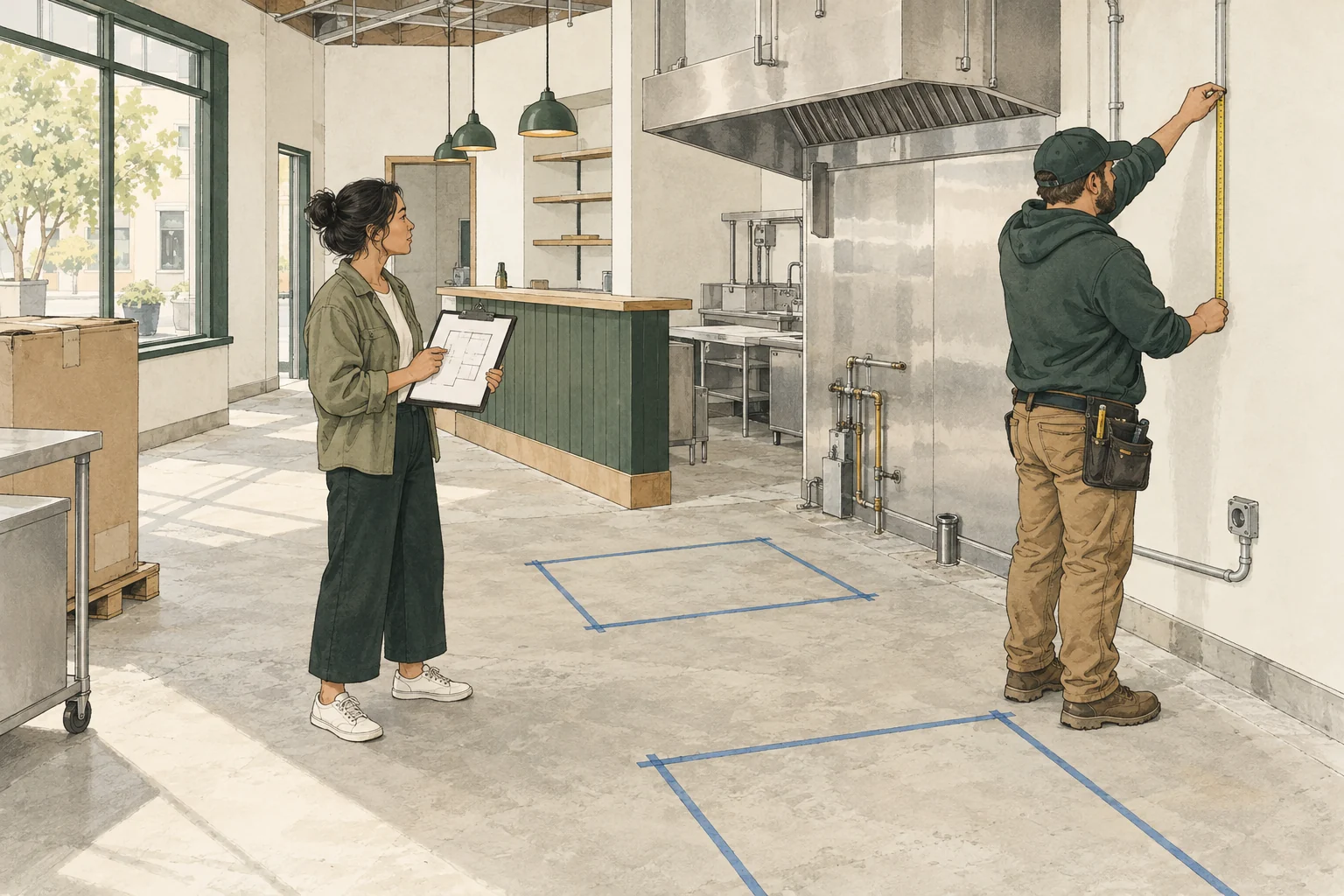
Inspect the actual premises and obtain quotes before fixing the startup budget. Concept illustration.
Cedar & Saffron is a fictional prelaunch restaurant, authored offline. Financial amounts come from its saved model. Inputs are illustrative and funding is proposed. The complete example includes the assumptions and open questions.
Inspect the full example ↗