

An example is most useful when it shows how the decisions connect. Read it as an operating argument: who buys, what they buy, how the business delivers and what the numbers require.
Borrow the questions and the structure. Replace the operating assumptions with your own evidence.
Begin with the customer and the offer.
Before reviewing a forecast, describe the buying occasion in one sentence. Cedar & Saffron proposes Mediterranean counter-service meals for nearby lunch customers, plus a small office-catering stream. Those are distinct occasions served by the same kitchen.
Now check whether the offer fits those occasions. A lunch order needs predictable speed, portioning and price. Catering needs a clear lead time, portion count and pickup process. A broad claim such as “everyone enjoys good food” would not explain either sales process.
Follow the operation behind the sales.
The restaurant assumes 130 counter orders per day, 26 operating days per month and a $17 average transaction. Catering assumes five monthly events, each with 30 meals at $18. These are illustrative inputs to validate, rather than observed sales.
Ask what must be true for that volume to happen. Can the team prepare and serve the menu at peak times? Does catering fit around lunch? Does the proposed location reach the intended customer? Reading these sections together exposes gaps that a polished executive summary can hide.
Underline one sales assumption. Find the capacity, staffing and acquisition decisions that support it.
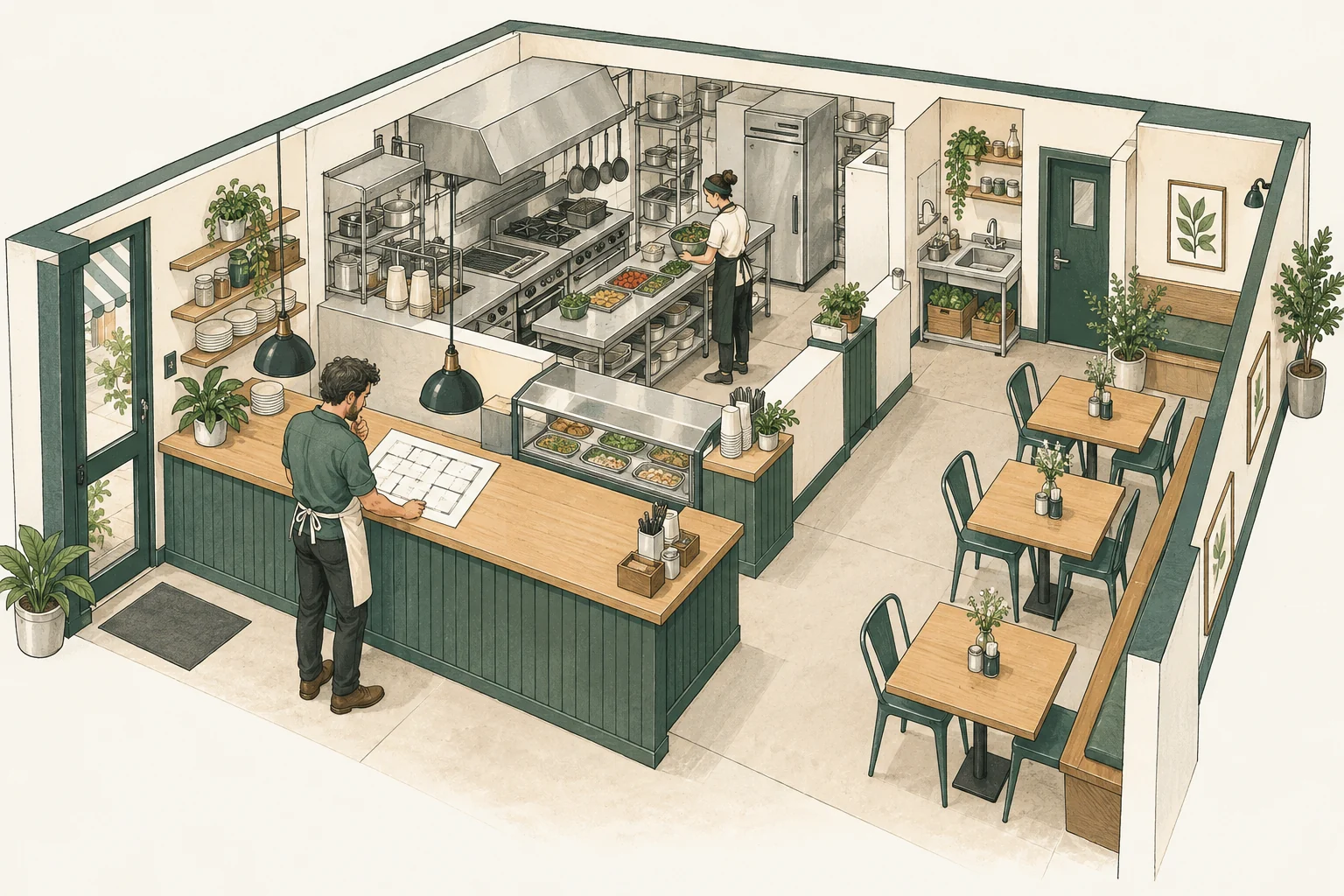
A plan connects the proposed offer, kitchen workflow and service capacity. Concept illustration, not a site drawing.
Separate what is known from what is assumed.
A useful plan makes its status clear. In our example, the business is fictional, the demand is untested and funding is proposed. A complete illustrative input is still an assumption; completeness alone does not make it verified.
Look for a concrete next step beside uncertainty: a paid menu test, a supplier quote, a site inspection or a shift schedule. “More research is needed” becomes useful when it names the decision and the evidence that could change it.
Read the financial result and the downside.
Do the financial statements reflect the operating story? The restaurant’s four-month ramp sits beside ongoing staffing and occupancy costs. Its first-year net income is negative. The funded cash scenario depends on the full proposed equity arriving before startup spending.
Read the risks immediately after the base case. A slower launch, extra site work or a change in payment terms should lead to an explicit model revision. Do not assume that cutting staff or increasing prices automatically solves a shortfall.
Turn the example into your own questions.
- Which customer and buying occasion are you serving?
- What paid evidence supports the offer?
- What capacity and people are needed to deliver it?
- Which costs need actual quotes?
- What funding must arrive, and when?
- What result would make you delay or redesign the launch?
Your plan should answer those questions in your own context. A restaurant’s staffing pattern, sales ramp and rent do not transfer unchanged to a cleaning company or software business.
Cedar & Saffron is a fictional prelaunch restaurant, authored offline. Financial amounts come from its saved model. Inputs are illustrative and funding is proposed. The complete example includes the assumptions and open questions.
Inspect the full example ↗