
Executive summary
Parcel Kitchen is a fictional single-site restaurant planning case in Austin, Texas. It demonstrates a complete business story, a saved native forecast and a ten-slide pitch. The decision is whether its particular sales mechanism and fixed commitments merit further paid testing, rather than whether restaurants in general are profitable.
Business overview
A delivery-first meal kitchen with direct pickup and marketplace orders in Austin, Texas. The kitchen sells a complete meal order. Direct pickup targets 45 orders a day at $23; marketplace orders target 75 a day at $25. Both channels use 26 open days and a four-month ramp. The modeled marketplace fee is 25% of that channel’s gross food sales. Local workers and households buying a prepared meal for pickup or delivery.
Key priorities
Test paid direct and marketplace batches. Measure recipe cost, packaging, dispatch accuracy, repeat orders and actual settlement days. Replace the fee and processing allowances with the signed channel terms. Opening is modeled for January 2027; permits, construction and hiring determine the real date. No paid traction, operating premises or founder track record is asserted.
Financial highlights
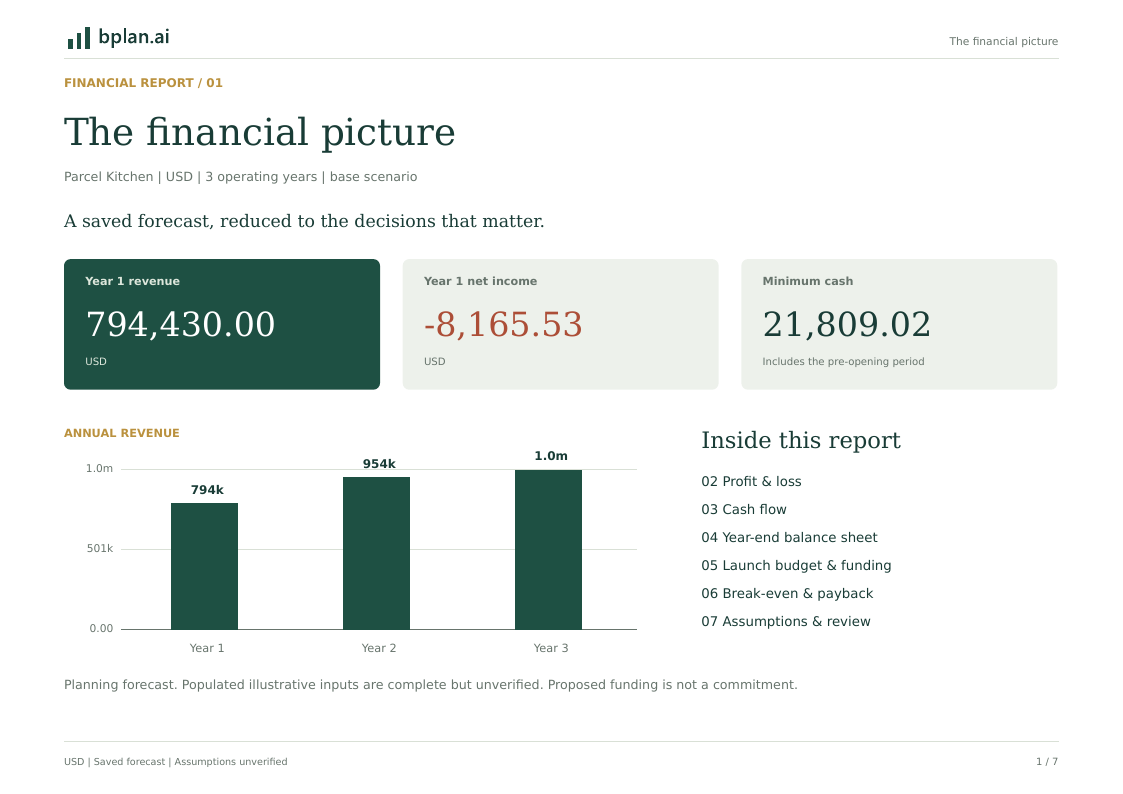
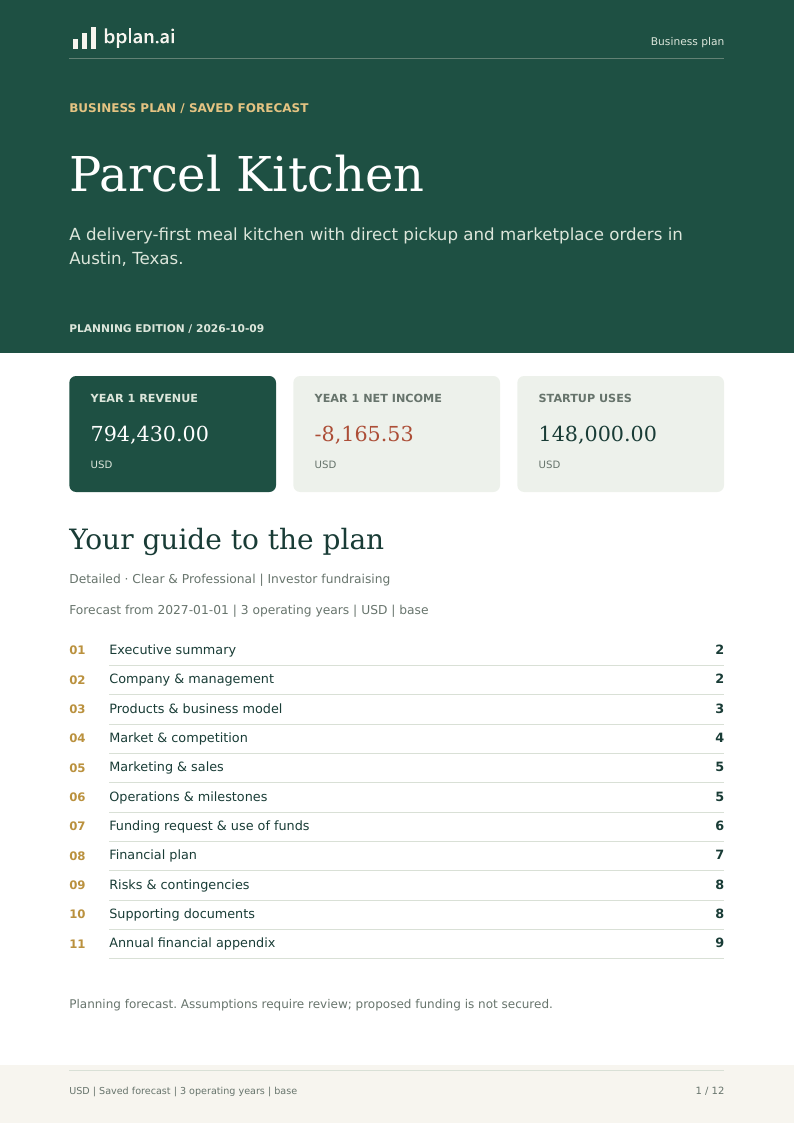
Proposed equity totals $210,000.00. Saved startup uses are $148,000.00, leaving $62,000.00 of opening cash. Year 1 revenue is $794,430.00 and net income is -$8,165.53. Minimum modeled cash is $21,809.02. The saved pre-tax project payback is 31.1 months.
- What paid evidence would support this specific format and sales target?
Company & management
The proposed business is independently operated at one site. A legal entity, signed lease and actual ownership agreement are not supplied. The fictional working-owner role makes responsibilities and compensation explicit without inventing a founder biography.
Company background
The scenario uses 1,000 sq ft of second-generation restaurant space and 0 dining seats. Monday–Saturday, lunch and dinner dispatch. Geography is Austin, Texas, USA; there is no actual street address or inspected property. The premises assumption must be replaced if the chosen site has materially different ventilation, power, drainage or accessibility requirements.
Ownership & management
A working owner would approve purchasing, oversee the staff schedule and review cash each week. No name, professional qualification or restaurant experience is represented as real. The proposed external investment has no agreed valuation, ownership percentage, board rights or distribution policy. Those terms need separate documentation and advice before fundraising.
Team & responsibilities
Working owner / kitchen manager: 1 × $4,500.00 per month, plus 15% employer allowance; Line cooks: 2 × $4,000.00 per month, plus 15% employer allowance; Prep / dispatch: 2 × $3,000.00 per month, plus 15% employer allowance. Orders enter separate direct and marketplace queues. Cooks batch shared preparation, finish to order, check packaging and move orders to a dispatch shelf. A paid courier arrangement is outside the direct-pickup channel. Headcount is an annual planning input, not a completed roster. Verify coverage for preparation, breaks, rest days and absence; do not assume the owner can fill unlimited unpaid hours.
- Can a detailed roster cover all service and preparation hours within this payroll?
Products & business model
The offer is defined by the purchase occasion and the unit sold. Format-specific revenue inputs are preserved in the saved model rather than converted into one generic restaurant average.
Products & services
A focused meal menu is designed for travel, packaging and short assembly time. The same kitchen fulfills direct pickup and marketplace delivery orders. The direct channel means pickup by the buyer, not an unbudgeted delivery fleet. Menu quality after travel, packaging leakage and dispatch errors are operating questions to test.
Pricing & revenue streams
The kitchen sells a complete meal order. Direct pickup targets 45 orders a day at $23; marketplace orders target 75 a day at $25. Both channels use 26 open days and a four-month ramp. The modeled marketplace fee is 25% of that channel’s gross food sales. Direct pickup meal orders: 45 per open day × 26 days × $23.00 at the end of a 4-month ramp. Daily capacity 70. Marketplace meal orders — food + channel fee: 75 per open day × 26 days × $25.00 at the end of a 4-month ramp. Daily capacity 110. Revenue is measured before customer sales tax and excludes tips. A target is constrained by the saved stream capacity; the forecast does not automatically turn every expression of interest into a sale.
Customer value
The proposed customer value is a reliable meal that arrives in usable condition or is ready for pickup. Direct ordering may improve channel contribution, but customers must first discover and use it. A higher marketplace price does not by itself offset a fee, packaging, refunds or longer settlement timing.
- What menu mix and actual recipe cost support the intended contribution?
Market & competition
This example identifies a customer and buying occasion, but it does not claim a measured address-level market, local market share or unmet demand. A city population is not multiplied into invented restaurant sales.
Target customers
Local workers and households buying a prepared meal for pickup or delivery. The eventual catchment must match travel time, purchase frequency and alternatives. Record who actually pays, who chooses the venue or channel and why that meal occasion matters. A target segment becomes useful evidence only when connected to paid behavior near the proposed operation.
Demand & validation
Test paid direct and marketplace batches. Measure recipe cost, packaging, dispatch accuracy, repeat orders and actual settlement days. Replace the fee and processing allowances with the signed channel terms. Preserve transaction records, realized prices, repeat orders, waste and service times. Set the minimum evidence threshold before evaluating a site; weak results should reduce the sales input or stop the launch. Forecast ramp months do not substitute for a validation process.
Competition & positioning
Other delivery listings, nearby takeaway kitchens and home cooking compete for the same meal. Compare the final customer price including applicable delivery charges, estimated service time, rating evidence and the condition of the meal after travel. No ranking, competitor sales or customer acquisition advantage is invented.
- Which paid signals would justify the volume at the eventual site?
Marketing & sales
Customer acquisition is a proposed operating process with a saved budget, not evidence of achieved channel return. The owner should connect activity to transactions and repeat purchasing before scaling spend.
Customer acquisition
Proposed channels are marketplace discovery, a direct pickup ordering page and targeted local introductions. The saved marketing allowance is $1,200.00 per month. Compare contribution after fees and marketing, not only the number of orders attributed to each channel. No customer acquisition cost is claimed.
Sales process
Direct buyers pay for pickup; the marketplace channel settles under its actual agreement. The saved model simplifies this to seven collection days across all sales. This conservatively delays the direct receipts as well; it is not a claim about any platform settlement schedule. Commission is modeled in marketplace cost of sales, once.
Retention & measurement
The proposed weekly review tracks repeat purchase, realized bill, complaints, refunds and contribution by buying occasion. Cost a discount before offering it; saved discounts and refunds are currently zero. Ask for feedback without inventing reviews, then revise the operating input when measured behavior supports the change.
- Which channel produces enough repeat contribution within the allowance?
Operations & milestones
The restaurant must deliver the planned volume with its actual kitchen, premises and paid team. Sales capacity and demand are separate inputs; a capacity ceiling is not a forecast that the kitchen will sell out.
Facilities & resources
The site assumption is 1,000 sq ft with 0 dining seats. Base rent is $2,600.00 plus $400.00 NNN/CAM per month. These are unquoted allowances. Second-generation kitchen refurbishment $45,000.00; Kitchen and refrigeration equipment $65,000.00; Dispatch shelves and packing stations $8,000.00; Order hardware and signage $4,000.00. Inspect hood, grease handling, power, fire safety, access and building condition before confirming the work scope.
Service delivery
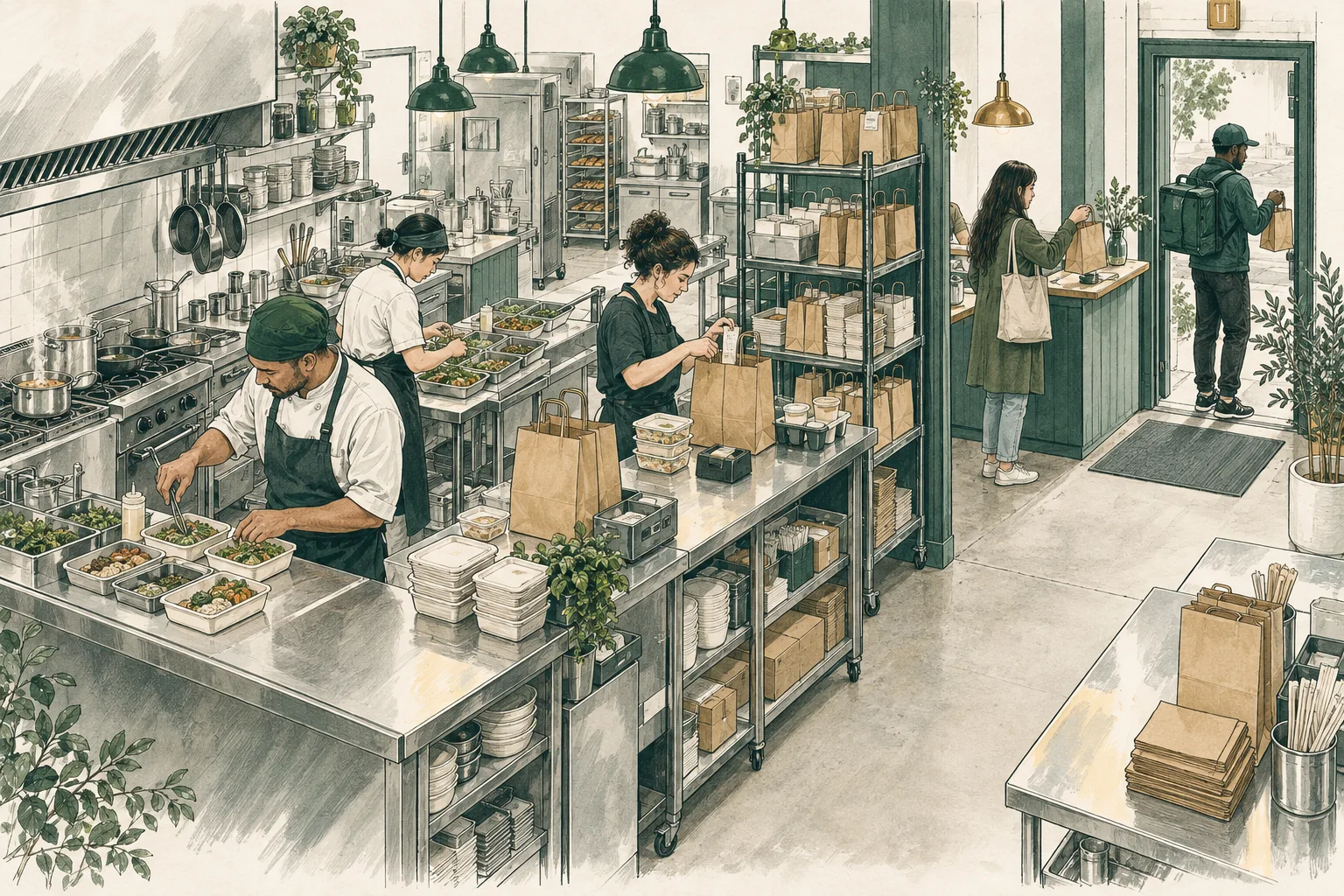
Orders enter separate direct and marketplace queues. Cooks batch shared preparation, finish to order, check packaging and move orders to a dispatch shelf. A paid courier arrangement is outside the direct-pickup channel. The two channels share a kitchen capacity of 180 orders per open day: 70 direct and 110 marketplace in the saved allocation. Peak dispatch congestion and food travel quality need paid tests. The model uses seven inventory days and seven supplier-payment days. Perishable stock still needs recipe-level purchasing and waste control; a modeled stock target does not establish safe food handling or supplier availability.
Launch & development milestones
The proposed sequence is paid menu testing, site inspection, conditional commercial terms, contractor and equipment quotes, permit review, hiring, training and a controlled soft opening. January 2027 is the modeled first operating month, not an approval promise. Do not compress permit or site-work dependencies merely to fit the forecast start date.
- Which site condition, approval or staffing gap could delay opening?
Funding request & use of funds
The funding scenario uses equity at prelaunch month 0, without debt. Proposed financing is kept separate from sales revenue and project profitability.
Use of funds
Saved startup uses total $148,000.00: $122,000.00 assets, $22,000.00 expensed setup and $4,000.00 opening stock. Second-generation kitchen refurbishment $45,000.00; Kitchen and refrigeration equipment $65,000.00; Dispatch shelves and packing stations $8,000.00; Order hardware and signage $4,000.00. Setup is an illustrative allowance for pre-opening occupancy, training, professional preparation and permissions. It is not an itemized quote or a promise that all site costs fit.
Sources of funding
The financialModel equity input is $210,000.00, comprising $60,000.00 proposed owner funding and $150,000.00 proposed external equity. Neither contribution is secured. The saved model assumes both are available before launch spending; later or partial contributions require a new cash scenario.
Owner contribution
The working owner contribution of $60,000.00 is fictional and must be verified for a real launch. Owner compensation is already included in payroll. Work contributed by the founder does not automatically pay a contractor invoice or provide the same liquidity as contributed cash.
Funding request
The external request is $150,000.00. Combined proposed funding leaves $62,000.00 opening cash. This is an operating reserve and unallocated contingency, not an extra startup expense. The saved funding gap is $0.00 in this particular funded scenario; a request and a gap are different measures.
- Are contributions available when deposits, setup and equipment payments fall due?
Financial plan
The native saved forecast covers 36 operating months, January 2027–December 2029, with prelaunch separately reported. All document and page amounts use this exact saved run.
Forecast assumptions
Direct pickup meal orders: 45 per open day × 26 days × $23.00 at the end of a 4-month ramp. Daily capacity 70. Marketplace meal orders — food + channel fee: 75 per open day × 26 days × $25.00 at the end of a 4-month ramp. Daily capacity 110. Marketplace variable cost combines 32% ingredients and an illustrative 25% channel fee. Direct orders carry 32% ingredients. Packaging adds 4% of total revenue and processing adds a 2% blended allowance. Fees are assumptions, not a platform offer. Working-owner pay is included; employer costs add 15%. The flat 21% income-tax provision is a simplified input, not a tax opinion. Prices grow 2% annually; units grow 3% annually subject to capacity. Fixed costs and wages grow 3% annually.
Financial outlook
Year 1: revenue $794,430.00, EBITDA $20,477.84, net income -$8,165.53, closing cash $64,163.71. Year 2: revenue $953,860.80, EBITDA $83,320.32, net income $49,680.74, closing cash $133,564.13. Year 3: revenue $1,002,126.12, EBITDA $94,837.32, net income $58,779.15, closing cash $212,026.82. EBITDA excludes depreciation, interest and income tax; net income includes the saved depreciation and tax provision. The operating years exclude prelaunch setup expense. A first-year result must be interpreted with the ramp and paid team intact.
Cash needs & financial resilience
The lowest modeled cash balance is $21,809.02. The saved funding gap is $0.00. First positive operating EBITDA occurs in month 4. The saved pre-tax project payback is 31.1 months. Cash differs from net income because of launch assets, depreciation, working capital and financing. Inspect the full cash-flow and balance-sheet reports before deciding the reserve is sufficient.
Debt & repayment
No loan draw, interest, principal repayment or lending approval is modeled. Adding debt requires its actual amount, draw date, interest rate and repayment terms in financialModel. The current equity-only forecast establishes neither bank affordability nor investor return. Project payback is a pre-tax operating measure, not a shareholder distribution schedule.
- Does the downside still have enough cash after all required site costs are included?
Risks & contingencies
The main risks follow from the chosen format, rather than from a generic list of restaurant challenges. The cash result depends on both the operating inputs and the full proposed equity arriving at prelaunch.
Key risks
The two channels share a kitchen capacity of 180 orders per open day: 70 direct and 110 marketplace in the saved allocation. Peak dispatch congestion and food travel quality need paid tests. Marketplace variable cost combines 32% ingredients and an illustrative 25% channel fee. Direct orders carry 32% ingredients. Packaging adds 4% of total revenue and processing adds a 2% blended allowance. Fees are assumptions, not a platform offer. No dine-in seats, direct courier fleet, shared-kitchen hourly contract, alcohol, debt, owner distributions or refundable deposits. The model assumes a dedicated second-generation kitchen, not a zero-fit-out virtual brand. Demand could ramp more slowly, recipes could waste more stock and staff coverage could cost more than assumed. Model omissions remain omissions even where the base case reconciles arithmetically.
Contingency actions
Test a higher marketplace share, a lower realized basket and longer collections while retaining the kitchen team. Review contribution by channel and weekly available cash. Direct ordering is a possible strategy to test, not an automatic replacement for paid marketplace demand. Delay commitments if evidence cannot support the required throughput.
- Which measured signal would cause the owner to redesign or postpone?
Supporting documents
The supplied material is the fictional operating specification, one saved financial run, this complete plan and the ten-slide pitch. No lease, vendor quote, permit, tax opinion or signed investment document is supplied.
Available supporting information
The delivered package includes the business-plan PDF with native annual financial appendix, seven-section financial-report PDF and ten-slide pitch-deck PDF. Their totals share one financialModel and saved calculation identity. The website displays actual PDF interiors and provides the complete files for inspection. Generated scene illustrations are conceptual, not photographs of premises.
Documents to obtain
Obtain paid-test records, recipe and packaging costs, equipment and refurbishment quotes, a premises inspection, actual lease and refundable-deposit terms, shift coverage, supplier and channel contracts, applicable permissions, entity/tax advice and funding commitments. Add each material change to the model, save a new run and regenerate all dependent documents together.
- Which missing evidence changes the decision before any money is committed?