
THE COMPLETE BUSINESS PLAN
A specific operating decision.
Can sold stylist time support the salaried roster after color stock, reception, premises and unsold appointment time?
Fictional editorial scenario. Prices, workload, base pay, expenses and owner funding are illustrative inputs. They are not current quotes, market averages, verified demand or actual company results. Employer taxes, benefits and income taxes are excluded; resulting net income is before omitted taxes.
The forecast shows a net loss in Year 1, Year 2, Year 3. Positive funded cash assumes the full proposed equity is received; it does not establish commercial viability.
01 / THE PLAN
Executive summary
Willow Chair proposes a salaried hair-service salon in Illustrative midsize US metro; no selected site. Willow Chair proposes hair services delivered by salaried stylists from a shared chair and stylist-hour budget, without booth rental or product-retail receipts. The central launch decision is: Can sold stylist time support the salaried roster after color stock, reception, premises and unsold appointment time?
Business overview
Local clients booking a defined haircut, color, styling or treatment service with an agreed time and price. Four paid stylists provide one 640-hour scheduled monthly pool, initially 50% billable. Four stations and two wash units support the work; five service shares allocate sold stylist time once. Prices are revenue per productive stylist hour, not appointment tickets or parallel chemical-processing time. The scenario is limited to this operating format; activity outside it needs its own inputs.
Key priorities
Test paid appointments with start/finish time, active stylist effort, products used, cancellation status and cash received. Compare collected hourly realization with the retained salary cost. Appointment requests and social follows are not billable hours, and an overbooked chair does not create another stylist. The proposed first operating month is January 2027. The owner should confirm service readiness, paid staffing and available cash before opening the calendar.
Financial highlights
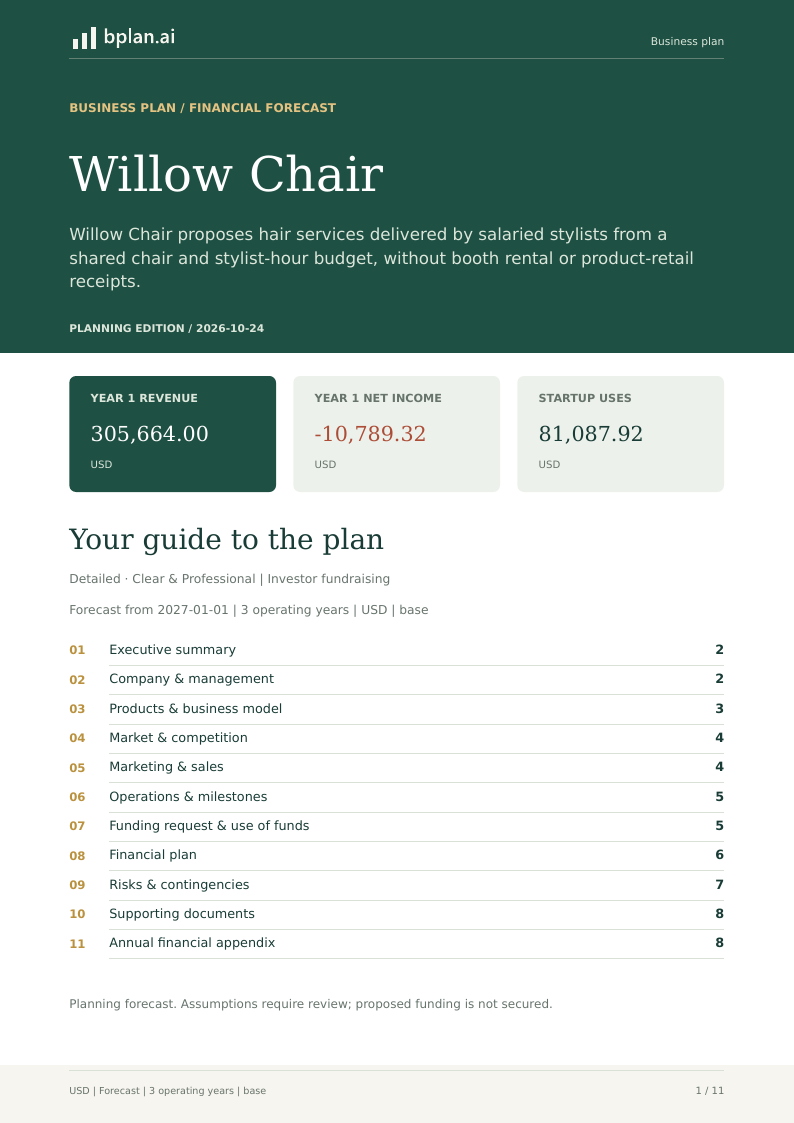
The proposal requires $155,822.29 in equity. Launch spending is $81,087.92, leaving $74,734.37 in opening cash. Year 1 revenue is $305,664.00 and net income is -$10,789.32. Depreciation and any interest charges bring the first-year net result below zero. Income taxes are excluded from this scenario, so the loss remains before those omitted taxes. The initial project outlay is not recovered within three operating years.
02 / THE PLAN
Company & management
Willow Chair proposes the operating format described in this example. The responsible management team must confirm legal formation, scope, paid staffing, commercial terms and cash controls before opening.
Company background
Willow Chair is a fictional employer salon with a compact leased-site concept. It has four styling stations and two wash units in the planning scope. No premises, professional qualification, license or client book is supplied. The business must establish suitable premises and qualified service coverage before trading.
Ownership & management
The proposed owner contribution is $155,822.29 and covers all modeled equity. No external equity is included. Contributions and operating remuneration are separate; the listed paid roles do not establish the owner's employment or tax status.
Team & responsibilities
Four salaried stylists supply all modeled service hours. The combined manager/reception budget covers commercial management and appointments, with working-owner management inside that paid allowance where appropriate. It is prorated coverage, not an additional full-time stylist or a second owner salary. Salaried stylists: 4 × $3,500.00 monthly, with no employer-cost allowance; Manager/reception: 1 × $2,933.33 monthly, with no employer-cost allowance. Paid roles are counted once in operating expenses. A zero employer allowance excludes burden from the forecast; it does not prove that no statutory charge or benefit is owed. Confirm the actual roster and fully loaded pay before launch.
03 / THE PLAN
Products & business model
The offer is limited to work the team can define, price and deliver consistently. Each agreement should identify the buyer, included tasks, access requirements, deliverables, acceptance and payment terms.
Products & services
Haircuts, single-process color, highlights, blowouts and treatments divide sold stylist time. Prices are hourly revenue equivalents, so an actual appointment price needs its actual duration and included products. Chemical processing cannot create two simultaneous sold hours for the same stylist.
Pricing & revenue streams
4 paid stylists provide 640.000 scheduled hours per month (160.000 per person). Requested sold time starts at 50% of allocated capacity and follows a 1-month ramp. Five service shares total 100%; each hour is allocated once. Uniform monthly demand is assumed. Requested work grows 0% annually, subject to the available-hour ceiling; fees grow 2% annually. Staffing stays fixed. Cuts and style: 35% of the shared capacity at $65.00 per billable hour. Color: 25% of the shared capacity at $85.00 per billable hour. Highlights: 20% of the shared capacity at $100.00 per billable hour. Blowouts: 12% of the shared capacity at $70.00 per billable hour. Treatments: 8% of the shared capacity at $90.00 per billable hour. Fees exclude customer sales tax. Confirm scope and any exceptional materials before accepting a fixed price. Displayed shares are rounded to two decimals; calculations retain the full-precision mix.
Customer value
The proposed benefit is a clearly scoped service, reliable appointment handling and a documented consultation. A client should know which color or treatment work is included and when a revised price is needed. No client outcome, certification or local price advantage is presented as established.
04 / THE PLAN
Market & competition
The initial market is the specific buyer and buying occasion described below. The launch should be justified by paid work in a practical service area, rather than by applying a market-share percentage to a broad industry estimate.
Target customers
Local clients booking a defined haircut, color, styling or treatment service with an agreed time and price. Confirm who commissions the work, who supplies access or records and who authorizes payment. Keep the initial territory small enough to support the promised response and delivery time.
Demand & validation
Test paid appointments with start/finish time, active stylist effort, products used, cancellation status and cash received. Compare collected hourly realization with the retained salary cost. Appointment requests and social follows are not billable hours, and an overbooked chair does not create another stylist.
Competition & positioning
Clients may choose independent stylists, other employee salons, home care or postpone discretionary color. Compare the full service and product scope, duration, qualification and appointment convenience. This case has no competitor ranking or demonstrated repeat-booking rate.
05 / THE PLAN
Marketing & sales
The acquisition process should bring in work that fits the team and produces collected contribution after delivery costs. Track qualified opportunities, accepted quotes, completed work and cash received as separate steps.
Customer acquisition
Proposed channels are truthful service listings, clearly labeled portfolio samples and neighborhood referrals. The local marketing allowance is separate from payroll and launch promotion. Track new paid clients and their total service effort, avoiding unsupported before-and-after or invented client testimonials.
Sales process
Consult, confirm the service and timing, agree the price, perform the work and collect at checkout. Customer trade credit is zero and tips are excluded from modeled revenue. Deposits and cancellation charges are not additional forecast income; actual prepayment rules require a cash-liability review.
Retention & measurement
Offer rebooking only into the real roster and monitor service satisfaction, cancellations and remedial work. An uncharged corrective appointment consumes paid time rather than creating new sales. Keep notes and product use sufficiently clear to quote the next service honestly.
06 / THE PLAN
Operations & milestones
Operating delivery must fit the actual premises, equipment, paid roster and service window. Confirm required resources and permissions before accepting customer or participant commitments.
Facilities & resources
Opening assets cover chairs, wash units, durable tools, plumbing fit-out, POS hardware, laundry/sanitation equipment and signage. Backbar color and disposable supplies remain purchased stock; external laundry and cleaning remain overhead. Site-specific plumbing, professional cover and permitted service scope need verification. Nonrefundable opening payments are prelaunch registration permits USD1200.00; prelaunch website setup USD1800.00; prelaunch launch marketing USD2500.00; prelaunch preopening training pay USD4200.00; prelaunch rent USD2800.00; prelaunch utilities connection USD350.00. These are preopening payments, distinct from ongoing payroll and overhead. The launch asset budget is Styling chairs and stations: $9,000.00; Wash units: $6,500.00; Hair tools and durable appliances: $3,000.00; Leasehold plumbing and fitout: $35,000.00; POS and computer hardware: $1,800.00; Laundry and sanitation equipment: $2,500.00; Durable signage: $2,200.00; Prelaunch refundable lease deposit: $5,600.00.
Service delivery
Book against qualified stylist availability, consult, prepare materials, perform the service, clean the station and reconcile payment. Wash-unit availability and different service skills can constrain the aggregate hour forecast. Track active service time separately from passive processing and client waiting.
Launch & development milestones
Verify professional and premises eligibility, installed plumbing/equipment quotes, insurance and a coverage roster. Complete paid service trials across the selected mix and review actual realization. Revise sold utilization only after cancellation, cleanup, leave and rework have been observed.
07 / THE PLAN
Funding request & use of funds
All proposed equity must be available before launch payments. The funding plan separates equipment and setup spending from the cash reserve needed to support operations.
Use of funds
Launch spending totals $81,087.92: $65,600.00 for assets and refundable deposits, $12,850.00 for expensed setup and $2,637.92 for opening inventory. Refundable deposits (Prelaunch refundable lease deposit: $5,600.00) are paid once before opening and held at cost without depreciation in the planning asset ledger. This aggregates their carrying value with other assets as a planning proxy; refund timing, impairment and formal accounting classification are not modeled. Deposit cash is unavailable for operations. Additional site work needs scoped quotes.
Sources of funding
Total proposed equity is $155,822.29, entirely from the owner. This contribution is uncommitted. No external investors or borrowing are included, and financing receipts are separate from earned revenue.
Owner contribution
The owner must confirm availability and transfer of the proposed $155,822.29 contribution. The saved payroll rows fund continuing operating work separately from contributed capital. Equipment, setup, supplier and payroll obligations require cash even when additional time is contributed.
Funding request
No external equity is requested. Receiving the proposed owner equity leaves $74,734.37 of opening cash and a forecast funding gap of $0.00. Confirm the owner's available funds and transfer date before committing launch payments.
08 / THE PLAN
Financial plan
The forecast covers January 2027–December 2029 in USD, with launch spending reported separately. Its usefulness depends on the service mix, fee, staffing cost and collection terms below.
Forecast assumptions
4 paid stylists provide 640.000 scheduled hours per month (160.000 per person). Requested sold time starts at 50% of allocated capacity and follows a 1-month ramp. Five service shares total 100%; each hour is allocated once. Uniform monthly demand is assumed. Requested work grows 0% annually, subject to the available-hour ceiling; fees grow 2% annually. Staffing stays fixed.
Named direct costs total 10.5% of operating receipts. Backbar color and treatment products: 9% of operating receipts, 100% allocated to tangible stock; Disposable service supplies: 1.5% of operating receipts, 100% allocated to tangible stock. Only tangible material shares enter purchased stock; purchased services, assistance and paid employee costs do not. All paid-role rows remain separate operating expenses. Fixed salary and overhead assumptions grow 3% annually. Collections use 0 days. Inventory uses 30 physical material days applied once to each material share. Supplier payments use 15 effective total-direct-cost days across material purchases and outside services, a blended timing approximation rather than a material-only credit schedule. Displayed rates and stock days are rounded to two decimals; calculations retain full input precision. The 0% income-tax provision is a scenario input. Entity income taxes are excluded; the resulting net figure is before those omitted taxes. This establishes no exempt status. Personal taxes and customer sales-tax remittances are outside this scenario. Role-specific employer allowances follow the saved payroll rows.
Financial outlook
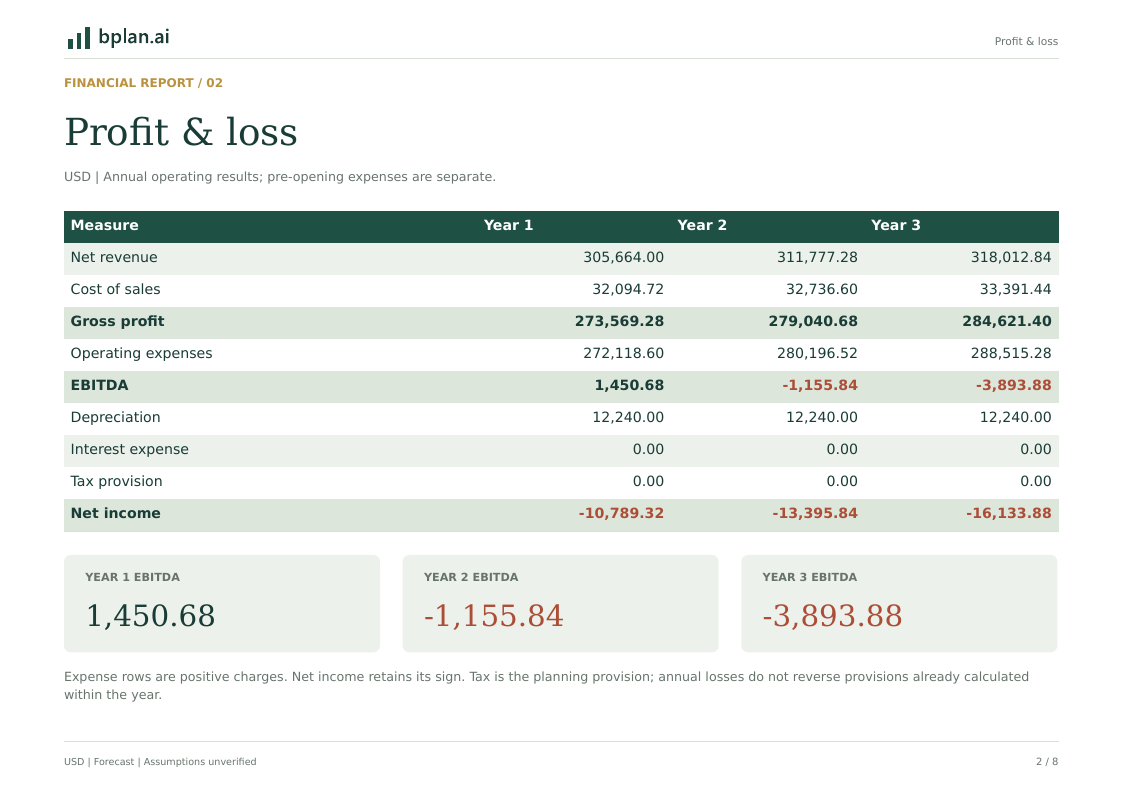
Year 1: revenue $305,664.00, EBITDA $1,450.68, net income -$10,789.32 and closing cash $77,485.69. Year 2: revenue $311,777.28, EBITDA -$1,155.84, net income -$13,395.84 and closing cash $76,303.11. Year 3: revenue $318,012.84, EBITDA -$3,893.88, net income -$16,133.88 and closing cash $72,381.94. Depreciation and any interest charges bring the first-year net result below zero. Income taxes are excluded from this scenario, so the loss remains before those omitted taxes. EBITDA excludes depreciation, interest and income tax; net income includes depreciation and the tax provision.
Cash needs & financial resilience
The lowest forecast cash balance is $72,381.94, and the funding gap is $0.00. Positive monthly operating EBITDA is first reached in month 1. The initial project outlay is not recovered within three operating years. Cash differs from profit because of equipment spending, depreciation, collection delays and financing. Review the monthly low point before committing the reserve.
Debt & repayment
No debt or investor distributions are included. Any borrowing option needs an amount, draw date, interest rate and repayment schedule before its affordability can be assessed. Pre-tax project payback measures recovery of the operating investment; it is not a promised dividend, investor return or financing approval.
09 / THE PLAN
Risks & contingencies
The main exposure is committing paid resources before collected sales justify them. The owner should use the service-specific risks below to decide when to narrow the offer, defer spending or stop.
Key risks
A more color-intensive mix may consume products or elapsed chair time faster than planned. Cancellations and absences leave base salaries and rent in place. The hour-equivalent forecast cannot prove that every booking fits the station and wash-unit schedule.
Contingency actions
Use timed service records and product consumption to revise appointment lengths and prices. Test fewer sold hours and higher backbar cost with the salaried roster retained. Limit bookings or narrow the offer when skills or cash do not support delivery; do not reclassify salary as unpaid owner work.
10 / THE PLAN
Supporting documents
The launch decision needs commercial evidence as well as a forecast. Maintain an organized working file so that costs, commitments and delivery capacity can be reviewed before money is spent.
Available supporting information
The operating proposal defines the customer, service boundary, paid roles, launch assets and collection terms. The accompanying annual financial statements set out earnings, cash flow and the balance sheet for the three-year period. All funding remains a proposal; the business is at the prelaunch stage.
Documents to obtain
Professional eligibility and establishment requirements, a selected lease, plumbing and equipment quotes, insurer and product terms, a chair/wash-unit roster, paid appointment records and proposed owner funds remain unverified. No existing client book or completed staff hiring is supplied. Record the actual fee, total delivery effort and date of payment for each trial assignment. Update the forecast and funding decision when quotes, commitments or measured results change a material assumption.
02 / THE FINANCIAL MODEL
How this business earns and uses cash.
4 paid stylists provide 640.000 scheduled hours per month (160.000 per person). Requested sold time starts at 50% of allocated capacity and follows a 1-month ramp. Five service shares total 100%; each hour is allocated once. Uniform monthly demand is assumed. Requested work grows 0% annually, subject to the available-hour ceiling; fees grow 2% annually. Staffing stays fixed.
The forecast covers three operating years, with prelaunch spending shown separately. Fees, workload, staffing and collection terms determine whether the business can cover its commitments and preserve cash.
| Category | Pool allocation | Base price | Billing unit |
|---|---|---|---|
| Cuts and style | 35% | $65.00 | One sold hour |
| Color | 25% | $85.00 | One sold hour |
| Highlights | 20% | $100.00 | One sold hour |
| Blowouts | 12% | $70.00 | One sold hour |
| Treatments | 8% | $90.00 | One sold hour |
| Cost or paid role | Base input | Treatment |
|---|---|---|
| Backbar color and treatment products | 9% of operating receipts | Cost of sales; 100% tangible stock |
| Disposable service supplies | 1.5% of operating receipts | Cost of sales; 100% tangible stock |
| Card processing fees | 2.8% of operating receipts | Operating expense |
| Rent and occupancy | $2,800.00/month before employer costs | Operating expense |
| Utilities | $450.00/month before employer costs | Operating expense |
| Laundry and cleaning | $350.00/month before employer costs | Operating expense |
| Booking and office software | $180.00/month before employer costs | Operating expense |
| Business insurance | $180.00/month before employer costs | Operating expense |
| Bookkeeping and professional services | $240.00/month before employer costs | Operating expense |
| Local marketing | $500.00/month before employer costs | Operating expense |
| Equipment maintenance | $150.00/month before employer costs | Operating expense |
| Licenses and staff education | $80.00/month before employer costs | Operating expense |
| Telephone and internet | $100.00/month before employer costs | Operating expense |
| Salaried stylists | $14,000.00/month before employer costs | Paid role; 0% employer allowance |
| Manager/reception | $2,933.33/month before employer costs | Paid role; 0% employer allowance |
| Input | Case value |
|---|---|
| Collection delay | 0 days |
| Physical material stock / effective direct-cost payment | 30 days / 15 days |
| Direct costs | 10.5% of operating receipts |
| Price / requested-demand growth | 2% / 0% annually |
| Salary and fixed-cost growth | 3% annually |
| Income-tax provision | 0% simplified provision |
| Proposed owner equity | $155,822.29 |
| Proposed external equity | $0.00 |
| Prelaunch setup | $12,850.00 |
Direct costs cover 10.5% of operating receipts and exclude the paid roles already shown in operating expenses. The material share uses the purchased-stock ledger; outside services remain direct expenses. All-in customer prices are not duplicated as extra parts or product revenue. Displayed rates and stock days are rounded to two decimals; calculations retain full input precision.
What the forecast shows
The forecast shows a net loss in Year 1, Year 2, Year 3. Net income includes depreciation and the monthly tax provision. EBITDA excludes depreciation, interest and tax; cash also reflects assets, working capital and financing.
| Measure | Year 1 · 2027 | Year 2 · 2028 | Year 3 · 2029 |
|---|---|---|---|
| Revenue | $305,664.00 | $311,777.28 | $318,012.84 |
| Cost of sales | $32,094.72 | $32,736.60 | $33,391.44 |
| Gross profit | $273,569.28 | $279,040.68 | $284,621.40 |
| Operating expenses | $272,118.60 | $280,196.52 | $288,515.28 |
| EBITDA | $1,450.68 | -$1,155.84 | -$3,893.88 |
| Depreciation | $12,240.00 | $12,240.00 | $12,240.00 |
| Interest | $0.00 | $0.00 | $0.00 |
| Tax provision | $0.00 | $0.00 | $0.00 |
| Net income | -$10,789.32 | -$13,395.84 | -$16,133.88 |
| Measure | Year 1 · 2027 | Year 2 · 2028 | Year 3 · 2029 |
|---|---|---|---|
| Opening cash | $74,734.37 | $77,485.69 | $76,303.11 |
| Customer collections | $305,664.00 | $311,777.28 | $318,012.84 |
| Supplier payments | $30,794.08 | $32,763.34 | $33,418.73 |
| Operating expenses paid | $272,118.60 | $280,196.52 | $288,515.28 |
| Interest paid | $0.00 | $0.00 | $0.00 |
| Tax provision paid | $0.00 | $0.00 | $0.00 |
| Operating cash flow | $2,751.32 | -$1,182.58 | -$3,921.17 |
| Investing cash flow | $0.00 | $0.00 | $0.00 |
| Financing cash flow | $0.00 | $0.00 | $0.00 |
| Net change | $2,751.32 | -$1,182.58 | -$3,921.17 |
| Closing cash | $77,485.69 | $76,303.11 | $72,381.94 |
| Measure | Year 1 · 2027 | Year 2 · 2028 | Year 3 · 2029 |
|---|---|---|---|
| Cash | $77,485.69 | $76,303.11 | $72,381.94 |
| Receivables | $0.00 | $0.00 | $0.00 |
| Inventory | $2,674.56 | $2,728.05 | $2,782.62 |
| Assets and deposits | $53,360.00 | $41,120.00 | $28,880.00 |
| Assets | $133,520.25 | $120,151.16 | $104,044.56 |
| Payables | $1,337.28 | $1,364.03 | $1,391.31 |
| Loan balance | $0.00 | $0.00 | $0.00 |
| Liabilities | $1,337.28 | $1,364.03 | $1,391.31 |
| Equity and retained earnings | $132,182.97 | $118,787.13 | $102,653.25 |
| Reconciliation difference | $0.00 | $0.00 | $0.00 |
Launch spending is $81,087.92; opening cash is $74,734.37 after all proposed equity. The unfunded gap is $0.00. Pre-tax project payback is not reached within 36 months. Project recovery is not an investor distribution.
Inspect the actual report
Planning limits and qualifications
Planning model, not audited accounts or tax advice. Revenue follows the selected sales or service activity. Any modeled subscriptions use monthly billing. Annual prepayments, milestone invoices, unbilled contract assets, customer taxes, seller settlements, capitalized interest and tax-loss carryforwards are not modeled. Refundable launch deposits are included at cost; refund timing, impairment and formal classification are outside scope.
Collection and supplier terms use 30-day monthly interpolation. Inventory purchases and non-stock direct costs use supplier terms; operating costs, setup costs, taxes and opening stock are paid immediately. Stock coverage applies only to linked goods costs. Production stock is tracked separately at unit cost.
Entity-level income tax is set to zero. No jurisdictional tax rules or owner personal taxes have been inferred.
Fictional editorial scenario. Prices, workload, base pay, expenses and owner funding are illustrative inputs. They are not current quotes, market averages, verified demand or actual company results. Employer taxes, benefits and income taxes are excluded; resulting net income is before omitted taxes.
Source initial scale, mix, base prices and paid roles are retained for Jan2027–Dec2029; later expansion is omitted. Volume is flat, prices grow2% and base/fixed costs3%. Income taxes and employer burden are excluded, not exempt. Named material COGS use physical stock days once; payable days retain the source effective mixed-cost input. Refundable deposits are paid once as nondepreciating asset-ledger proxies; refund timing is not modeled. Native depreciation is added. Full scope/timing changes are explained in the operating prose.
Role-specific employer-cost allowances follow the saved paid-role rows; zero excludes employer burden rather than proving no obligation. The 0% income-tax provision is an explicit scenario input. A zero input excludes entity income taxes from these results and establishes no exemption; personal taxes, customer sales-tax receipts/remittances and distributions are outside the scenario.
All equity is proposed, uncommitted month-0 cash. No debt is modeled. Opening cash is a reserve, not an extra startup expense. Asset/setup/insurance/premises allowances need scoped quotes; the listed refundable deposits are included, while unquoted additional site works are excluded.
Inventory days are physical material coverage applied once to each named COGS row’s inventory share. Payment days are the effective blended delay across all direct-cost purchases and services, not a physical material supplier term. The shared payment schedule is a simplified timing proxy; material-specific supplier schedules are not modeled.
Refundable deposits are paid once before opening and retained at cost without depreciation in the planning asset ledger. Assets and deposits are aggregated as a planning proxy; their formal accounting classification, impairment, refund timing and recovery are not modeled. Deposit cash is not available operating cash.
03 / ACTUAL TEN-SLIDE PITCH
A focused funding conversation.
All ten pages of the delivered PDF. Buyer demand, team roles and funding remain proposed.
Willow Chair
Every slide is available in the complete ten-slide PDF. The full slide text follows.
Read the complete slide outline
1. Willow Chair
Paid stylist time. An honest service scope.
Fictional prelaunch
2. Cancellations leave the salaried chair unfilled.
Paid delivery capacity
50% sold-time target
Preparation and support also take time.
Paid work will test time and margin.
3. A clear scope. A controlled delivery process.
Agree
Schedule
Deliver
Collect
One agreed scope. Documented acceptance.
4. Start with a reachable buying occasion.
Local clients
A haircut or styling visit
Color clients
A scoped color appointment
Schematic; buyers and area to validate.
5. Every service draws from one pool of hours.
Mix
Cuts and style 35%
65/h
Color 25%
85/h
Highlights 20%
100/h
Blowouts 12%
70/h
Treatments 8%
90/h
USD / sold hour; illustrative shared-time mix.
6. Compete on the job and the commercial terms.
Possible alternatives
Check before booking
Other hair salons
Active stylist time
Independent stylists
Products and corrections
Home care or deferral
Rebooking and collection
Compare equivalent work and written terms.
7. Fund the launch. Keep a reserve.
155,822.29
Proposed equity
81,087.92
Launch uses
74,734.37
Opening cash
Year 1 net loss: USD -10,789.32
Minimum cash: USD 72,381.94
8. Proposed team. Clear delivery responsibilities.
Monthly base pay
Salaried stylists
14,000.00
Manager/reception
2,933.33
Stylists and manager/reception receive base pay.
9. Prove the job economics before adding capacity.
Paid visits
Timed services
Product log
Prelaunch. These are the next tests.
10. Proposed owner equity.
USD 155,822.29
External equity requested: USD 0.00
Terms and funding remain uncommitted.
Project payback: not reached within 36 months
KEEP THE COMPLETE EXAMPLE
Three matching documents.
Free fictional sample PDFs. Actual page counts and byte sizes are shown below.
Business plan
11 pages · A4 portrait
95,966 bytes · PDF
Financial report
8 pages · A4 landscape
66,497 bytes · PDF
Pitch deck
10 pages · 16:9 landscape
47,530 bytes · PDF
Build around your own decisions.
Use your own service boundary, actual quotes, paid staffing and payment terms. Review every assumption before preparing your own package.
Create a plan like this ↗