
THE COMPLETE BUSINESS PLAN
A specific operating decision.
Can one paid service route cover its van, safe access and support costs through the seasonal calendar?
Fictional editorial scenario. Prices, workload, wages, costs and financing are illustrative planning inputs, not current quotes, measured local averages or actual company results.
The forecast shows a net loss in Year 1, Year 2, Year 3. Positive funded cash assumes the full proposed equity is received; it does not establish commercial viability.
01 / THE PLAN
Executive summary
Hearthline Route proposes a single-van residential chimney service in Midwest suburban United States; jurisdiction to be selected. A proposed single-route residential chimney and vent service selling defined cleaning, inspection and limited maintenance tasks from one paid owner-technician. The central launch decision is: Can one paid service route cover its van, safe access and support costs through the seasonal calendar?
Business overview
Homeowners and small residential property operators seeking an agreed chimney, fireplace or dryer-vent task at a site with suitable access and an authorized payer. One equipped van and one paid owner-technician provide 160 scheduled hours monthly. Five services allocate the sold-hour pool once, with an illustrative seasonal pattern. Quarter-time remote administration supports bookings but creates no second route. The business will accept assignments within this service boundary and quote separately or refer work that falls outside it.
Key priorities
Test paid visits in a narrow route area and record travel, access assessment, setup, active service time, consumables, callbacks and collection. The twelve monthly weights are illustrative rather than an observed local booking series. Paid demand must support the quiet months as well as the heating-season peak. Do not infer automatic annual renewals from a general maintenance recommendation. The proposed first operating month is January 2027. The owner should confirm service readiness, paid staffing and available cash before opening the calendar.
Financial highlights
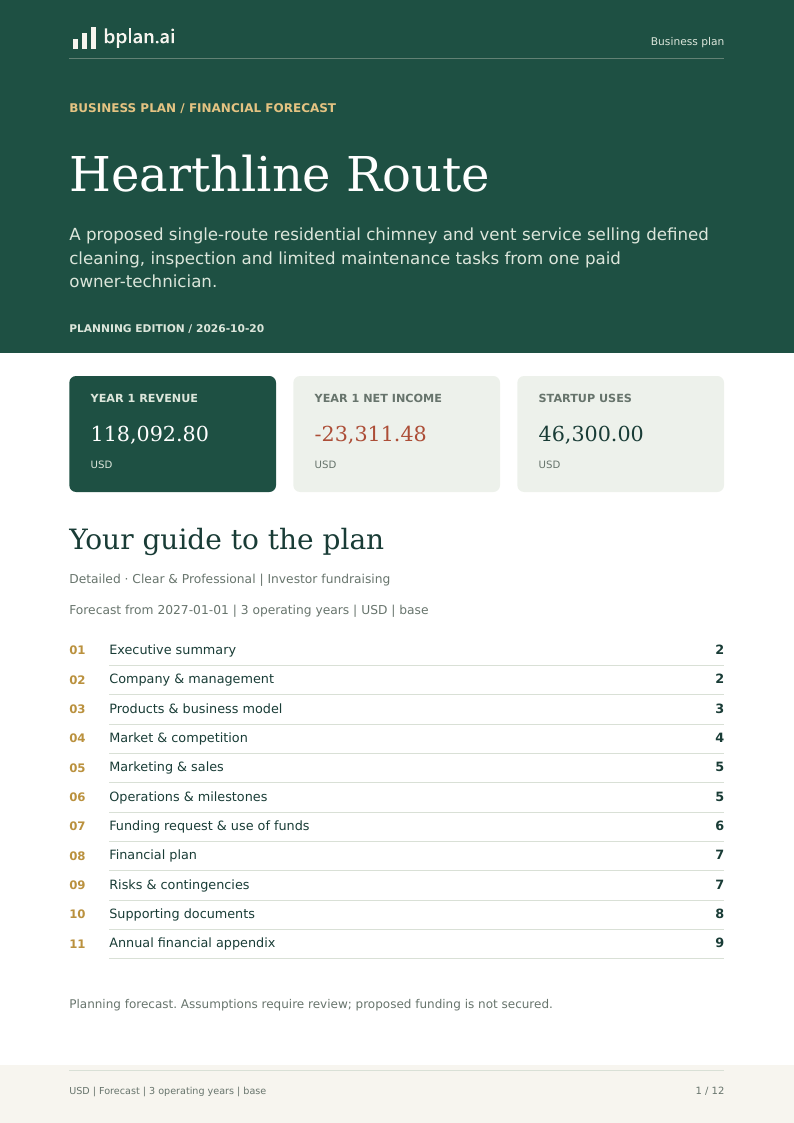
The proposal requires $85,000.00 in equity. Launch spending is $46,300.00, leaving $38,700.00 in opening cash. Year 1 revenue is $118,092.80 and net income is -$23,311.48. The first-year operating shortfall means sales do not yet cover the paid team and overhead. Funding provides time to establish demand; it does not remove that shortfall. The initial project outlay is not recovered within three operating years.
02 / THE PLAN
Company & management
Hearthline Route will operate as an independent service business. The working owner will control scope, staffing, commercial terms and weekly cash decisions; legal formation and the ownership agreement must be completed before trading.
Company background
Hearthline Route is a fictional mobile service for a compact Midwest suburban territory, with a home office and secure equipment storage. The proposed format has one van and no customer storefront or construction crew. No actual jurisdiction, credential, address or existing route is supplied. The owner must confirm the competent service boundary, insurance and permissions before accepting real work.
Ownership & management
The proposed owner contribution is $50,000.00; the remaining $35,000.00 is sought from external equity investors. The owner is also paid for an operating role. Investment valuation, ownership percentages, voting rights and distribution terms remain to be agreed.
Team & responsibilities
The owner is the only productive technician and receives a full salary. Quarter-time remote administration is a separate paid coverage budget for calls, scheduling and invoice intake. Outside disposal and job-support purchases remain in direct costs; they do not add an employee or a second revenue pool. The roster must reserve real time for travel, setup, records, training and unsuitable-access decisions within the nonbillable allowance. Owner-technician: 1 × $5,000.00 monthly, plus a 15% employer-cost allowance; Administration: 1 × $833.33 monthly, plus a 15% employer-cost allowance. A weekly roster must cover delivery, preparation, travel, administration, leave and absence. The owner’s salary appears once in payroll; contributed time is not an additional cash contribution.
03 / THE PLAN
Products & business model
The offer is limited to work the team can define, price and deliver consistently. Each agreement should identify the buyer, included tasks, access requirements, deliverables, acceptance and payment terms.
Products & services
The five services are chimney sweeping, video inspection, limited gas-fireplace maintenance, dryer-vent cleaning and minor cap or hardware repairs. They use one shared technician-hour pool. Major rebuilding, relining, gas-line work and structural construction are excluded. Agree precisely which maintenance is within the operator’s competence and equipment. An inspection hour is not sold again inside a separately allocated sweep without changing the scope and time budget.
Pricing & revenue streams
1 paid owner-technician provides 160.000 scheduled hours per month (160.000 per person). Requested sold time starts at 40% of allocated capacity and follows a 3-month ramp. Five service shares total 100%; each hour is allocated once. The twelve seasonal weights average one and change requested hours, with capacity retained. Requested work grows 8% annually, subject to the available-hour ceiling; fees grow 2% annually. Staffing stays fixed. Sweeping: 50% of the shared capacity at $165.00 per billable hour. Video inspection: 15% of the shared capacity at $200.00 per billable hour. Fireplace care: 15% of the shared capacity at $150.00 per billable hour. Dryer vents: 10% of the shared capacity at $150.00 per billable hour. Minor repairs: 10% of the shared capacity at $180.00 per billable hour. Fees exclude customer sales tax. Confirm scope and any exceptional materials before accepting a fixed price.
Customer value
The proposed value is a defined service visit with documented observations, accepted work and a clear referral boundary. CPSC recommends annual professional inspection of fuel-burning heating systems, but that general advice does not verify this operator’s qualifications or create its bookings. A cleaning or maintenance visit is not a guarantee against fire, carbon monoxide or future defects. Explain what was inspected, what was done and what needs specialist attention.
04 / THE PLAN
Market & competition
The initial market is the specific buyer and buying occasion described below. The launch should be justified by paid work in a practical service area, rather than by applying a market-share percentage to a broad industry estimate.
Target customers
Homeowners and small residential property operators seeking an agreed chimney, fireplace or dryer-vent task at a site with suitable access and an authorized payer. Confirm who commissions the work, who supplies access or records and who authorizes payment. Keep the initial territory small enough to support the promised response and delivery time.
Demand & validation
Test paid visits in a narrow route area and record travel, access assessment, setup, active service time, consumables, callbacks and collection. The twelve monthly weights are illustrative rather than an observed local booking series. Paid demand must support the quiet months as well as the heating-season peak. Do not infer automatic annual renewals from a general maintenance recommendation.
Competition & positioning
Alternatives include another qualified chimney-service operator, a suitable fireplace specialist or postponing nonurgent work after appropriate advice. Compare the actual inspection, cleaning and limited repair boundary, access assumptions and written deliverable. Major defects belong with a capable specialist under a new scope. The case supplies no local competitor prices, safety ranking or market share.
05 / THE PLAN
Marketing & sales
The acquisition process should bring in work that fits the team and produces collected contribution after delivery costs. Track qualified opportunities, accepted quotes, completed work and cash received as separate steps.
Customer acquisition
The proposed channels are clear local service information, relevant property-owner introductions and referrals after accepted work. The fixed brand budget is distinct from activity-linked referral/campaign fees and launch promotion. Ask whether each booked visit fits a compact route and the available equipment. Marketing must describe the actual scope without claiming a credential, approval or guaranteed protection that has not been established.
Sales process
Qualify the appliance/task and access conditions, agree the service and payer, and confirm competence before offering a visit. Collect payment on completion under the scenario terms; no customer credit or advance annual service plan is assumed. Ordinary materials and direct support are inside the selected fee economics. A major defect or inaccessible site requires a separate decision rather than an automatic repair sale.
Retention & measurement
Keep a clear service record and invite a future scoped visit when the customer has an appropriate need. A reminder is not a booked or prepaid contract. Track repeat paid work, callback causes and actual route time before treating the territory as an established round. Obtain permission before using property photographs or service records in promotion.
06 / THE PLAN
Operations & milestones
Delivery must fit the paid team’s hours, equipment and service window. Work should enter the calendar only after scope, competence, access and required resources are confirmed.
Facilities & resources
The launch budget includes the used van, HEPA vacuum, video camera, rotary brushes/rods, access equipment and reporting hardware. Stock covers ordinary consumables and small repair parts only; outside services cannot be stocked. Recurring maintenance and calibration are separate from initial equipment purchases. Actual vehicle condition, storage access, insured tasks, equipment compatibility and additional site requirements need suitable quotes and checks. The launch asset budget is Used service van: $25,000.00; HEPA chimney vacuum: $2,800.00; Inspection camera: $6,500.00; Rotary brushes and rods: $1,500.00; Ladders and access equipment: $1,500.00; Tablet and computer: $1,200.00.
Service delivery
Confirm the task, assess readiness and access, perform only agreed work within competence, document observations and obtain acceptance before collection. This is a commercial workflow rather than a technical safety procedure. Travel and preparation consume the same owner’s day. A seasonal demand peak does not create extra staffed van capacity, and work beyond the service boundary should be referred or separately assessed.
Launch & development milestones
Before opening, choose the territory and jurisdiction, verify suitable training and coverage, inspect the vehicle/equipment and agree task/access terms. Complete paid trial visits with an hour and callback log. Review quiet-month cash before filling a larger service calendar. January 2027 is a planning start; there is no issued credential, established route or paid trial in this example.
07 / THE PLAN
Funding request & use of funds
All proposed equity must be available before launch payments. The funding plan separates equipment and setup spending from the cash reserve needed to support operations.
Use of funds
Launch spending totals $46,300.00: $38,500.00 for assets, $6,800.00 for expensed setup and $1,000.00 for opening inventory. Setup covers an allowance for formation, professional preparation, training and launch work. Refundable premises deposits and additional site work are excluded until scoped quotes are available.
Sources of funding
Total proposed equity is $85,000.00, comprising $50,000.00 from the owner and $35,000.00 from external investors. Neither contribution is committed. No borrowing is included, and financing receipts are separate from earned revenue.
Owner contribution
The owner must confirm the availability and transfer date of the $50,000.00 contribution. Salary pays for the owner’s continuing operating work. The company still needs cash for payroll, equipment and supplier invoices, even when the owner contributes additional time.
Funding request
The external equity request is $35,000.00. Receiving all proposed equity leaves $38,700.00 of opening cash and a forecast funding gap of $0.00. The gap measures a cash shortfall after assumed funding; it is not a substitute for the investment request. Agree investor rights and reporting before accepting funds.
08 / THE PLAN
Financial plan
The forecast covers January 2027–December 2029 in USD, with launch spending reported separately. Its usefulness depends on the service mix, fee, staffing cost and collection terms below.
Forecast assumptions
1 paid owner-technician provides 160.000 scheduled hours per month (160.000 per person). Requested sold time starts at 40% of allocated capacity and follows a 3-month ramp. Five service shares total 100%; each hour is allocated once. The twelve seasonal weights average one and change requested hours, with capacity retained. Requested work grows 8% annually, subject to the available-hour ceiling; fees grow 2% annually. Staffing stays fixed. Direct costs are 10% of net fees. Only purchased materials enter inventory; outside services are not stocked. Salaries are operating expenses, outside the direct-cost ratio. Salaries and fixed overhead grow 3% annually. Collections take 0 days, supplier payments 0 days and inventory coverage 30 days. The 21% flat income-tax provision and 15% employer-cost allowance are simplified planning inputs.
Financial outlook
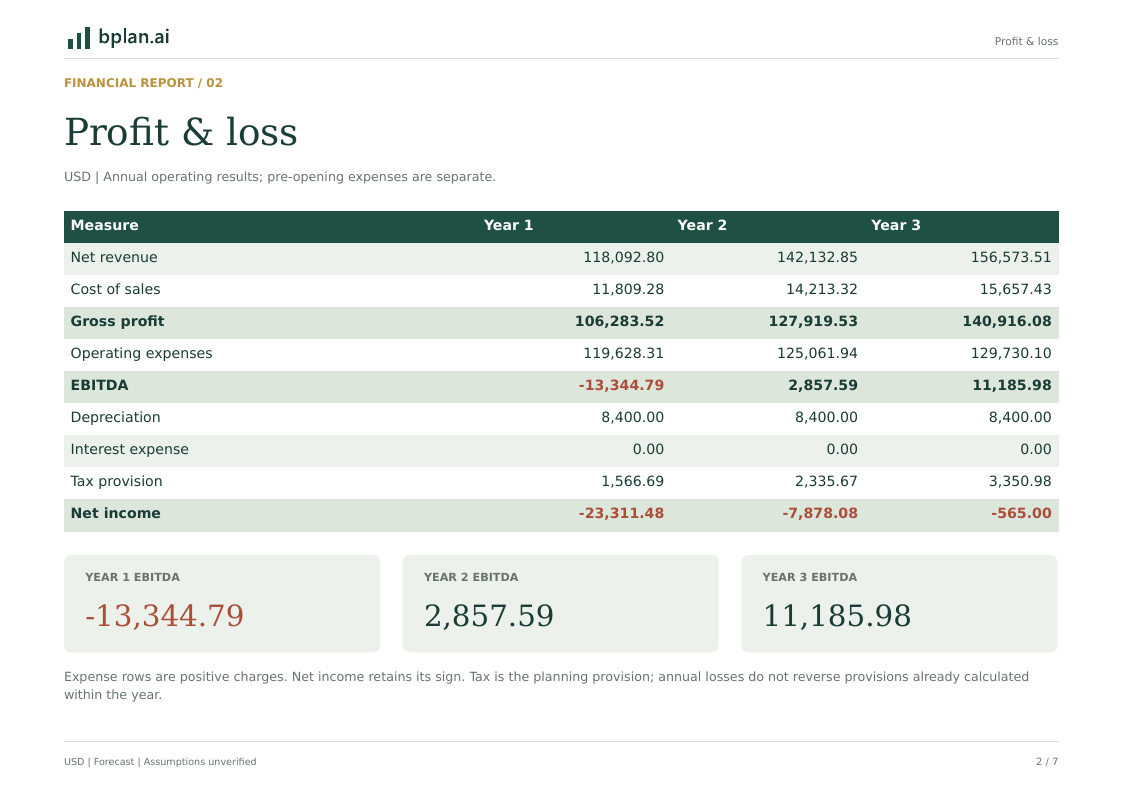
Year 1: revenue $118,092.80, EBITDA -$13,344.79, net income -$23,311.48 and closing cash $23,799.34. Year 2: revenue $142,132.85, EBITDA $2,857.59, net income -$7,878.08 and closing cash $24,220.76. Year 3: revenue $156,573.51, EBITDA $11,185.98, net income -$565.00 and closing cash $31,945.03. The first-year operating shortfall means sales do not yet cover the paid team and overhead. Funding provides time to establish demand; it does not remove that shortfall. EBITDA excludes depreciation, interest and income tax; net income includes depreciation and the tax provision.
Cash needs & financial resilience
The lowest forecast cash balance is $12,885.18, and the funding gap is $0.00. Positive monthly operating EBITDA is first reached in month 9. The initial project outlay is not recovered within three operating years. Cash differs from profit because of equipment spending, depreciation, collection delays and financing. Review the monthly low point before committing the reserve.
Debt & repayment
No debt or investor distributions are included. Any borrowing option needs an amount, draw date, interest rate and repayment schedule before its affordability can be assessed. Pre-tax project payback measures recovery of the operating investment; it is not a promised dividend, investor return or financing approval.
09 / THE PLAN
Risks & contingencies
The main exposure is committing paid resources before collected sales justify them. The owner should use the service-specific risks below to decide when to narrow the offer, defer spending or stop.
Key risks
The van, paid owner and support continue to cost money during weak seasonal demand. Unsuitable access, weather, more complex deposits or defects, equipment failure and callbacks can reduce completed work. The forecast’s seasonal weights do not establish a safe operating window or actual local demand. Limited repair stock and outside support allowances may prove insufficient for real tasks.
Contingency actions
Use a narrow service boundary, access checks, suitable insurance and a documented specialist referral process. Log the all-in route day and callback effort before accepting more work. Test lower quiet-month utilization, extra travel and equipment disruption while retaining owner compensation and vehicle costs. A forecast loss or cash concern should change scope, timing or commitments rather than turn the owner’s labor into a free input.
10 / THE PLAN
Supporting documents
The launch decision needs commercial evidence as well as a forecast. Maintain an organized working file so that costs, commitments and delivery capacity can be reviewed before money is spent.
Available supporting information
The operating proposal defines the customer, service boundary, paid roles, launch assets and collection terms. The accompanying annual financial statements set out earnings, cash flow and the balance sheet for the three-year period. All funding remains a proposal; the business is at the prelaunch stage.
Documents to obtain
Verified competencies and applicable permissions, suitable job/access procedures, configured insurance, vehicle and equipment checks, storage/deposit terms, material and disposal quotes, paid visit logs and equity commitments remain outstanding. No real professional certification, issued inspection approval, customer route, completed safety assessment or secured financing is provided. Record the actual fee, total delivery effort and date of payment for each trial assignment. Update the forecast and funding decision when quotes, commitments or measured results change a material assumption.
02 / THE FINANCIAL MODEL
How this business earns and uses cash.
1 paid owner-technician provides 160.000 scheduled hours per month (160.000 per person). Requested sold time starts at 40% of allocated capacity and follows a 3-month ramp. Five service shares total 100%; each hour is allocated once. The twelve seasonal weights average one and change requested hours, with capacity retained. Requested work grows 8% annually, subject to the available-hour ceiling; fees grow 2% annually. Staffing stays fixed.
The forecast covers three operating years, with prelaunch spending shown separately. Fees, workload, staffing and collection terms determine whether the business can cover its commitments and preserve cash.
| Service | Pool allocation | Base price | Billing unit |
|---|---|---|---|
| Sweeping | 50% | $165.00 | One sold hour |
| Video inspection | 15% | $200.00 | One sold hour |
| Fireplace care | 15% | $150.00 | One sold hour |
| Dryer vents | 10% | $150.00 | One sold hour |
| Minor repairs | 10% | $180.00 | One sold hour |
| Cost or paid role | Base input | Treatment |
|---|---|---|
| Owner-technician | $5,000.00/month before employer costs | Paid role; 15% employer allowance |
| Administration | $833.33/month before employer costs | Paid role; 15% employer allowance |
| Equipment storage | $450.00/month before employer costs | Operating expense |
| Business auto and tool cover | $550.00/month before employer costs | Operating expense |
| Scheduling software | $150.00/month before employer costs | Operating expense |
| Phone and connectivity | $100.00/month before employer costs | Operating expense |
| Vehicle maintenance | $200.00/month before employer costs | Operating expense |
| Tool maintenance | $150.00/month before employer costs | Operating expense |
| Brand marketing | $450.00/month before employer costs | Operating expense |
| Accounting and professional | $150.00/month before employer costs | Operating expense |
| Training and renewals | $75.00/month before employer costs | Operating expense |
| Home-office utilities | $100.00/month before employer costs | Operating expense |
| Collection fees | 2.5% of net fees | Operating expense |
| Route fuel | 3.5% of net fees | Operating expense |
| Referral and campaign fees | 3% of net fees | Operating expense |
| Input | Case value |
|---|---|
| Collection delay | 0 days |
| Inventory / supplier payment | 30 days / 0 days |
| Direct costs | 10% of net fees |
| Price / requested-demand growth | 2% / 8% annually |
| Salary and fixed-cost growth | 3% annually |
| Income-tax provision | 21% simplified provision |
| Proposed owner equity | $50,000.00 |
| Proposed external equity | $35,000.00 |
| Prelaunch setup | $6,800.00 |
Direct costs cover 10% of fees and exclude the paid roles already shown in operating expenses. The material share uses the purchased-stock ledger; outside services remain direct expenses. All-in customer prices are not duplicated as extra parts or product revenue.
What the forecast shows
The forecast shows a net loss in Year 1, Year 2, Year 3. Net income includes depreciation and the monthly tax provision. EBITDA excludes depreciation, interest and tax; cash also reflects assets, working capital and financing.
| Measure | Year 1 · 2027 | Year 2 · 2028 | Year 3 · 2029 |
|---|---|---|---|
| Revenue | $118,092.80 | $142,132.85 | $156,573.51 |
| Cost of sales | $11,809.28 | $14,213.32 | $15,657.43 |
| Gross profit | $106,283.52 | $127,919.53 | $140,916.08 |
| Operating expenses | $119,628.31 | $125,061.94 | $129,730.10 |
| EBITDA | -$13,344.79 | $2,857.59 | $11,185.98 |
| Depreciation | $8,400.00 | $8,400.00 | $8,400.00 |
| Interest | $0.00 | $0.00 | $0.00 |
| Tax provision | $1,566.69 | $2,335.67 | $3,350.98 |
| Net income | -$23,311.48 | -$7,878.08 | -$565.00 |
| Measure | Year 1 · 2027 | Year 2 · 2028 | Year 3 · 2029 |
|---|---|---|---|
| Opening cash | $38,700.00 | $23,799.34 | $24,220.76 |
| Customer collections | $118,092.80 | $142,132.85 | $156,573.51 |
| Supplier payments | $11,798.46 | $14,313.82 | $15,768.16 |
| Operating expenses paid | $119,628.31 | $125,061.94 | $129,730.10 |
| Interest paid | $0.00 | $0.00 | $0.00 |
| Tax provision paid | $1,566.69 | $2,335.67 | $3,350.98 |
| Operating cash flow | -$14,900.66 | $421.42 | $7,724.27 |
| Investing cash flow | $0.00 | $0.00 | $0.00 |
| Financing cash flow | $0.00 | $0.00 | $0.00 |
| Net change | -$14,900.66 | $421.42 | $7,724.27 |
| Closing cash | $23,799.34 | $24,220.76 | $31,945.03 |
| Measure | Year 1 · 2027 | Year 2 · 2028 | Year 3 · 2029 |
|---|---|---|---|
| Cash | $23,799.34 | $24,220.76 | $31,945.03 |
| Receivables | $0.00 | $0.00 | $0.00 |
| Inventory | $989.18 | $1,089.68 | $1,200.41 |
| Net fixed assets | $30,100.00 | $21,700.00 | $13,300.00 |
| Assets | $54,888.52 | $47,010.44 | $46,445.44 |
| Payables | $0.00 | $0.00 | $0.00 |
| Loan balance | $0.00 | $0.00 | $0.00 |
| Liabilities | $0.00 | $0.00 | $0.00 |
| Equity and retained earnings | $54,888.52 | $47,010.44 | $46,445.44 |
| Reconciliation difference | $0.00 | $0.00 | $0.00 |
Launch spending is $46,300.00; opening cash is $38,700.00 after all proposed equity. The unfunded gap is $0.00. Pre-tax project payback is not reached within 36 months. Project recovery is not an investor distribution.
Inspect the actual report
Planning limits and qualifications
Planning model, not audited accounts or tax advice. Revenue is invoiced as earned; monthly subscriptions only. Annual prepayments, refundable deposits, milestone invoices, unbilled contract assets, customer taxes, seller settlements, capitalized interest and tax-loss carryforwards are not modeled.
Collection and supplier terms use 30-day monthly interpolation. Inventory purchases and non-stock direct costs use supplier terms; operating costs, setup costs, taxes and opening stock are paid immediately. Stock coverage applies only to linked goods costs. Production stock is tracked separately at unit cost.
Fictional editorial scenario. Prices, workload, wages, costs and financing are illustrative planning inputs, not current quotes, measured local averages or actual company results.
Five-year source adapted to 36 months with one paid owner route and quarter-time admin fixed. Original service shares, fees and seasonal weights remain; three-month ramp and 8% requested-hour growth replace utilization steps, with 2% fee and 3% payroll/overhead growth. Direct costs are 8% goods and 2% outside support. Thirty physical stock days replace the source 24-day total-cost equivalent. Setup paid once, no repeat salary. Equity proposed; deposit/site works excluded. Tax and employer allowance illustrative.
A 15% illustrative employer allowance is added to paid salaries. The flat 21% native tax provision is a simplified planning input, not an entity or personal tax opinion. Customer sales-tax receipts/remittances and owner distributions are outside this scenario.
All equity is proposed, uncommitted month-0 cash. No debt is modeled. Opening cash is a reserve, not an extra startup expense. Asset/setup/insurance/premises allowances need scoped quotes; refundable premises deposits and site-specific additional works are excluded.
03 / ACTUAL TEN-SLIDE PITCH
A focused funding conversation.
All ten pages of the delivered PDF. Buyer demand, team roles and funding remain proposed.
Hearthline Route
Every slide is available in the complete ten-slide PDF. The full slide text follows.
Read the complete slide outline
1. Hearthline Route
Defined chimney work, on one accountable route.
Fictional prelaunch
2. Seasonal gaps leave the same paid van and owner idle.
Paid delivery capacity
40% sold-time target
Preparation and support also take time.
Paid work will test time and margin.
3. A clear scope. A controlled delivery process.
Agree
Schedule
Deliver
Collect
One agreed scope. Documented acceptance.
4. Start with a reachable buying occasion.
Homeowners
An agreed chimney visit
Property operators
A defined vent service
Schematic; buyers and area to validate.
5. Every service draws from one pool of hours.
Mix
Sweeping 50%
165/h
Video inspection 15%
200/h
Fireplace care 15%
150/h
Dryer vents 10%
150/h
Minor repairs 10%
180/h
USD / sold hour; illustrative shared-time mix.
6. Compete on the job and the commercial terms.
Possible alternatives
Check before booking
Another chimney firm
Service and access
Fireplace specialist
Total route effort
Specialist referral
Qualifications and cover
Compare equivalent work and written terms.
7. Fund the launch. Keep a reserve.
85,000.00
Proposed equity
46,300.00
Launch uses
38,700.00
Opening cash
Year 1 net loss: USD -23,311.48
Minimum cash: USD 12,885.18
8. Proposed team. Clear delivery responsibilities.
Monthly base pay
Owner-technician
5,000.00
Administration
833.33
One paid owner route, with paid admin support.
9. Prove the job economics before adding capacity.
Paid visit
Route hours
Cash margin
Prelaunch. These are the next tests.
10. Proposed external equity.
USD 35,000.00
Owner contribution: USD 50,000.00
Terms and funding remain uncommitted.
Project payback: not reached within 36 months
KEEP THE COMPLETE EXAMPLE
Three matching documents.
Free fictional sample PDFs. Actual page counts and byte sizes are shown below.
Business plan
12 pages · A4 portrait
97,407 bytes · PDF
Financial report
7 pages · A4 landscape
62,584 bytes · PDF
Pitch deck
10 pages · 16:9 landscape
46,892 bytes · PDF
Build around your own decisions.
Use your own service boundary, actual quotes, paid staffing and payment terms. Review every assumption before preparing your own package.
Create a plan like this ↗