
THE COMPLETE BUSINESS PLAN
A specific operating decision.
Can unrestricted receipts fund the paid mission team, participant aid and opening cash needs without relying on restricted money?
Fictional editorial scenario. Prices, workload, wages, costs and financing are illustrative planning inputs, not current quotes, measured local averages or actual organization results.
The forecast shows a net loss in Year 1, Year 2, Year 3. Positive funded cash assumes the full proposed opening contributions is received; it does not establish commercial viability.
01 / THE PLAN
Executive summary
CommonHarbor Community proposes community education and basic-needs nonprofit cash-planning scenario in Illustrative mid-cost US metropolitan service area. Unrestricted support for community education and basic-needs programs. The launch decision is: Can unrestricted receipts fund the paid mission team, participant aid and opening cash needs without relying on restricted money? This narrow unrestricted scenario excludes restricted or conditional funds, release schedules, grant liabilities, endowments and exempt-tax determinations. All operating receipts are unconditional unrestricted support or earned program receipts recognized in their modeled periods; any surplus is retained for mission activity and is never distributed.
Business overview
Individual and major donors, foundations and sponsors making unconditional unrestricted commitments, plus participants paying for completed eligible program activity. The source assumes 1,000 qualified opportunities monthly and 12% completion, giving one pool of 120 completed funding/program engagements before seasonality. Five receipt channels allocate that pool once. These are heterogeneous expected engagements, not employee hours, unique donors, enrollment capacity or a donor-retention forecast. The scenario is limited to this operating format; activity outside it needs its own inputs.
Key priorities
Validate usable funding alongside actual program delivery: terms, receipts, participant records and paid resources. The blended completion rate covers unlike opportunities; it is not a web conversion benchmark or proof staff can handle every seasonal peak. The proposed first operating month is January 2027. the governing team should confirm service readiness, paid staffing and available cash before opening the calendar.
Financial highlights
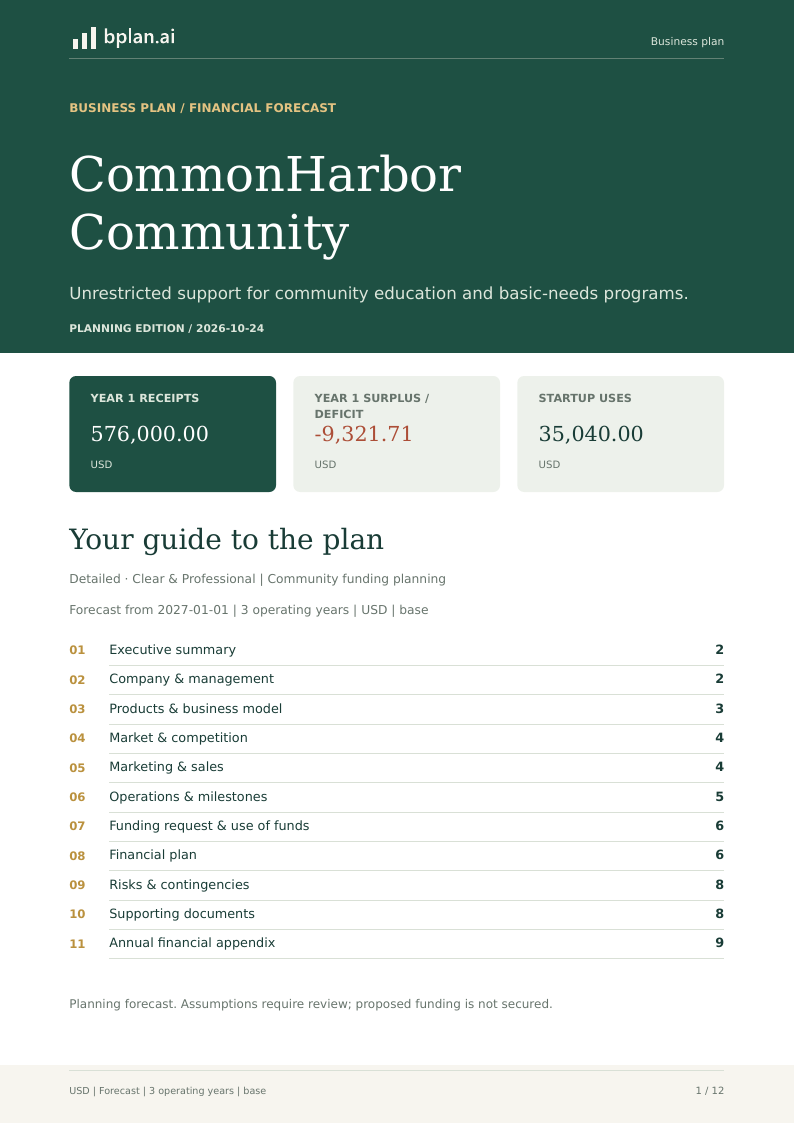
Proposed unrestricted opening contributions total $209,486.51. Launch spending is $35,040.00, leaving $174,446.51 in opening cash. Year 1 operating receipts are $576,000.00 and the modeled surplus or deficit is -$9,321.71. A negative result remains a mission-funding shortfall; opening cash does not remove it.
02 / THE PLAN
Company & management
CommonHarbor Community is a fictional community organization with proposed governance and paid operating roles. Legal formation, governance duties and charitable or tax status require independent confirmation. This narrow unrestricted scenario excludes restricted or conditional funds, release schedules, grant liabilities, endowments and exempt-tax determinations. All operating receipts are unconditional unrestricted support or earned program receipts recognized in their modeled periods; any surplus is retained for mission activity and is never distributed.
Company background
CommonHarbor Community is a fictional organization planning education and basic-needs activity from leased space. Only unconditional unrestricted support and completed program receipts enter this scenario. The source’s assumed exempt/public-charity status is not adopted as achieved or verified.
Ownership & management
The governing body would control mission delivery and approve the budget. Opening contributions confer no investor ownership, distribution or return rights. The standard balance-sheet equation is used only as an opening-net-assets planning proxy; it does not provide nonprofit fund accounting.
Team & responsibilities
Two program coordinators, three-quarter-time executive direction, half-time fundraising and half-time administration are paid. Fractional rows are prorated budgets. Outside instructors are separate paid services; volunteer support replaces none of the retained salary commitments. Program team: 2 × $4,166.67 monthly, plus a 15% employer-cost allowance; Director budget: 1 × $5,000.00 monthly, plus a 15% employer-cost allowance; Fundraising: 1 × $2,708.33 monthly, plus a 15% employer-cost allowance; Administration: 1 × $2,000.00 monthly, plus a 15% employer-cost allowance. Paid roles are counted once in operating expenses. A zero employer allowance excludes burden from the forecast; it does not prove that no statutory charge or benefit is owed. Confirm the actual roster and fully loaded pay before launch.
03 / THE PLAN
Products & business model
Five channels provide unconditional unrestricted support or earned program receipts. Confirm purpose, terms and participant eligibility; the amounts are illustrative receipts per completed engagement, not investor interests or secured commitments.
Products & services
Donations, major gifts, foundation grants, sponsorships and program fees retain all five channel shares and amounts. Foundation/sponsor entries are limited to unconditional unrestricted support without an uncompleted exchange obligation. Other awards or unearned payments require different accounting and cash treatment.
Pricing & revenue streams
120 completed funding or program engagements per month before the 1-month ramp and normalized seasonality. The 5 mutually exclusive channels allocate this one pool once; each amount is an unrestricted receipt per completed engagement, not a donor balance, employee hour or recurring commitment. Requested engagements grow 0% annually and amounts grow 2%. This narrow scenario recognizes unconditional unrestricted contributions and earned program receipts in their modeled periods. Restricted or conditional awards, release schedules, grant liabilities and exempt-tax determinations are outside the scenario. Donations: 60% of the shared demand pool at $75.00 per completed funding or program engagement. Major gifts: 15% of the shared demand pool at $500.00 per completed funding or program engagement. Foundations: 2% of the shared demand pool at $10,000.00 per completed funding or program engagement. Sponsors: 3% of the shared demand pool at $2,000.00 per completed funding or program engagement. Program fees: 20% of the shared demand pool at $100.00 per completed funding or program engagement. Each amount is an illustrative unrestricted receipt per engagement. Confirm funding terms, recognition and permitted use before committing program spending. Displayed shares are rounded to two decimals; calculations retain the full-precision mix.
Customer value
The purpose is defined community support funded at full operating cost. Delivery needs eligibility and activity records. A donation is support rather than a sale of guaranteed outcomes, and participation does not establish measured social impact.
04 / THE PLAN
Market & competition
The initial scope identifies supporters, sponsors and eligible participants. Validate usable funding and program need through documented commitments and activity; the scenario establishes neither donor demand nor achieved community outcomes.
Target customers
Individual and major donors, foundations and sponsors making unconditional unrestricted commitments, plus participants paying for completed eligible program activity. Identify who authorizes unrestricted support, when funds become usable and which completed participant activity earns a program fee.
Demand & validation
Validate usable funding alongside actual program delivery: terms, receipts, participant records and paid resources. The blended completion rate covers unlike opportunities; it is not a web conversion benchmark or proof staff can handle every seasonal peak.
Competition & positioning
Supporters and participants may choose other community programs, public/charitable providers or direct aid. Compare purpose, eligibility, evidence and full costs without claiming others’ results. No priority grant access or measured unmet-need estimate is asserted.
05 / THE PLAN
Marketing & sales
Outreach should align the program scope with unconditional unrestricted support and earned program receipts. Track qualified opportunities, completed engagements, documented activity and cash received as separate steps.
Customer acquisition
Proposed channels are accurate community outreach and supporter relationships. Campaign/event spending differs from fundraising salary. Distinguish intended mission, completed work and verified funding status; the case supplies no donor endorsement.
Sales process
Confirm unconditional unrestricted terms before treating support as usable, and recognize program receipts for completed activity only. Twenty-five weighted collection days approximate the retained mix. Restricted pledges, grant milestones and advance program liabilities are excluded rather than treated as available cash.
Retention & measurement
Keep appropriate supporter acknowledgments, use records and participant feedback. A later gift or attendance is a new engagement in the modeled pool. No renewal, recurring donor balance or grant continuation is assumed.
06 / THE PLAN
Operations & milestones
Operating delivery must fit the actual premises, equipment, paid roster and service window. Confirm required resources and permissions before accepting customer or participant commitments.
Facilities & resources
Computers/network equipment, program furniture and reusable workshop equipment support launch. Participant supplies are stock; cash aid/mini-grants and instructors are separate direct expenditures. The leased room creates no modeled enrollment capacity or free technology eligibility. The refundable premises deposit is paid before opening and remains at cost without depreciation in the asset ledger; no refund is assumed. This aggregation is a planning proxy rather than formal accounting classification. The launch asset budget is Computers and secure network: $6,500.00; Office and program furniture: $5,500.00; Reusable workshop equipment: $4,000.00; Prelaunch refundable lease deposit: $5,000.00.
Service delivery
Confirm usable funding and participant scope, schedule paid staff/instructors, procure supplies, deliver activity and document assistance and receipts. A foundation engagement and a participant payment have different real processes despite sharing the source expected-engagement pool.
Launch & development milestones
Verify governance, formation, funding terms, activity limits, premises and insurance before launch. Complete a documented support and program cycle before expansion. Tax obligations and nonprofit accounting need separate review; zero modeled tax records excluded scope, not an exemption determination.
07 / THE PLAN
Funding request & use of funds
Proposed unrestricted opening contributions must arrive before launch payments. They are separate from operating-period donations, grants, sponsorships and earned program receipts.
Use of funds
Launch spending totals $35,040.00: $21,000.00 for assets and refundable deposits, $11,800.00 for expensed setup and $2,240.00 for opening inventory. Refundable deposits (Prelaunch refundable lease deposit: $5,000.00) are paid once before opening and held at cost without depreciation in the planning asset ledger. This aggregates their carrying value with other assets as a planning proxy; refund timing, impairment and formal accounting classification are not modeled. Deposit cash is unavailable for operations. Additional site work needs scoped quotes.
Sources of funding
Opening contributions total $209,486.51, all proposed and uncommitted. No investor equity, borrowing or distribution rights are included. The opening contribution is counted once and is separate from annual funding and program receipts. This narrow unrestricted scenario excludes restricted or conditional funds, release schedules, grant liabilities, endowments and exempt-tax determinations. All operating receipts are unconditional unrestricted support or earned program receipts recognized in their modeled periods; any surplus is retained for mission activity and is never distributed.
Opening contribution
Confirm written unconditional unrestricted commitments, the remittance date and governance authorization before making launch payments. Paid employees and purchased program services remain costs regardless of volunteer support.
Funding request
Proposed opening contributions of $209,486.51 leave $174,446.51 in opening cash and a modeled funding gap of $0.00. This is a contribution proposal, with no investor ownership or financial return. Confirm availability and permitted use before committing spending.
08 / THE PLAN
Financial plan
The forecast covers January 2027–December 2029 in USD, with launch spending separate. It depends on the funding-channel mix, illustrative amounts, paid mission resources and collection timing.
Forecast assumptions
120 completed funding or program engagements per month before the 1-month ramp and normalized seasonality. The 5 mutually exclusive channels allocate this one pool once; each amount is an unrestricted receipt per completed engagement, not a donor balance, employee hour or recurring commitment. Requested engagements grow 0% annually and amounts grow 2%. This narrow scenario recognizes unconditional unrestricted contributions and earned program receipts in their modeled periods. Restricted or conditional awards, release schedules, grant liabilities and exempt-tax determinations are outside the scenario.
Named direct costs total 43% of operating receipts. Program materials and participant supplies: 10% of operating receipts, 100% allocated to tangible stock; Participant aid and community mini-grants: 25% of operating receipts, 0% allocated to tangible stock; Contract program instructors: 8% of operating receipts, 0% allocated to tangible stock. Only tangible material shares enter purchased stock; purchased services, assistance and paid employee costs do not. All paid-role rows remain separate operating expenses. Fixed salary and overhead assumptions grow 3% annually. Collections use 25 days. Inventory uses 14 physical material days applied once to each material share. Supplier payments use 3 effective total-direct-cost days across material purchases and outside services, a blended timing approximation rather than a material-only credit schedule. Displayed rates and stock days are rounded to two decimals; calculations retain full input precision. The 0% income-tax provision is a scenario input. Entity income taxes are excluded; the resulting net figure is before those omitted taxes. This establishes no exempt status. Personal taxes and customer sales-tax remittances are outside this scenario. Role-specific employer allowances follow the saved payroll rows.
Financial outlook
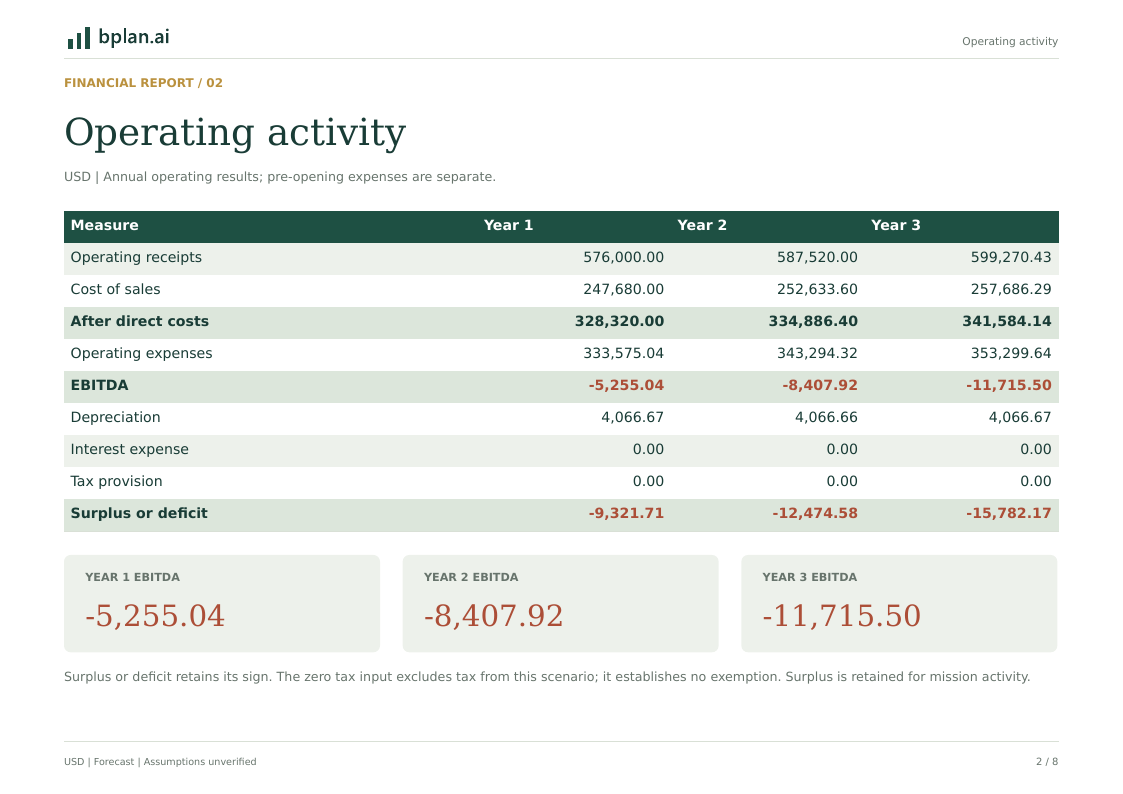
Year 1: operating receipts $576,000.00, EBITDA -$5,255.04, surplus or deficit -$9,321.71 and closing cash $99,215.47. Year 2: operating receipts $587,520.00, EBITDA -$8,407.92, surplus or deficit -$12,474.58 and closing cash $89,363.23. Year 3: operating receipts $599,270.43, EBITDA -$11,715.50, surplus or deficit -$15,782.17 and closing cash $76,174.53. A deficit remains a mission-funding shortfall; opening contributions do not remove it. EBITDA excludes depreciation, interest and income tax. The zero provision excludes income taxes and establishes no exemption.
Cash needs & financial resilience
Minimum modeled cash is $75,139.09 and the funding gap is $0.00. Review monthly cash before committing program spending. The project-payback calculation is a pre-financing cash diagnostic; no donor return or distribution is intended. This narrow unrestricted scenario excludes restricted or conditional funds, release schedules, grant liabilities, endowments and exempt-tax determinations. All operating receipts are unconditional unrestricted support or earned program receipts recognized in their modeled periods; any surplus is retained for mission activity and is never distributed.
Debt & repayment
No borrowing, distributions or donor financial returns are modeled. Pre-tax project-payback arithmetic is only a cash-recovery diagnostic for the initial operating outlay; it is not a payout, charitable outcome or funding approval.
09 / THE PLAN
Risks & contingencies
The main exposure is committing paid mission resources before usable funding arrives. The governing team should use the activity-specific risks below to narrow the program, defer spending or pause commitments.
Key risks
The small foundation-engagement share supplies large receipts, so failed or delayed awards can sharply reduce cash. Aid and salaries continue in quiet months. Restricted or conditional funds cannot substitute without revising recognition, availability and reporting.
Contingency actions
Review terms before spending, stage commitments against usable cash and monitor major-support concentration. Test fewer foundation engagements and delayed receipts with all paid roles retained. Preserve shortfalls and postpone activity when usable funds are inadequate.
10 / THE PLAN
Supporting documents
The launch decision needs documented governance, funding terms, participant eligibility, program costs and a cash forecast. Keep the supporting records available before committing money.
Available supporting information
The operating proposal defines the customer, service boundary, paid roles, launch assets and collection terms. The accompanying annual financial statements set out earnings, cash flow and the balance sheet for the three-year period. All funding remains a proposal; the business is at the prelaunch stage.
Documents to obtain
Actual governance/formation, tax/accounting review, unconditional unrestricted funding terms, aid/participant policies, instructor/insurance quotes, premises and paid program records remain outstanding. No exempt determination, grant award, donor commitment or measured social outcome is supplied. Record funding terms, completed activity, total program cost and receipt dates. Update the forecast when quotes, commitments or measured results change a material assumption.
02 / THE FINANCIAL MODEL
How this business earns and uses cash.
120 completed funding or program engagements per month before the 1-month ramp and normalized seasonality. The 5 mutually exclusive channels allocate this one pool once; each amount is an unrestricted receipt per completed engagement, not a donor balance, employee hour or recurring commitment. Requested engagements grow 0% annually and amounts grow 2%. This narrow scenario recognizes unconditional unrestricted contributions and earned program receipts in their modeled periods. Restricted or conditional awards, release schedules, grant liabilities and exempt-tax determinations are outside the scenario.
The forecast covers three operating years, with prelaunch spending shown separately. Fees, workload, staffing and collection terms determine whether the business can cover its commitments and preserve cash.
| Channel | Pool allocation | Receipt per engagement | Activity unit |
|---|---|---|---|
| Donations | 60% | $75.00 | One completed funding or program engagement |
| Major gifts | 15% | $500.00 | One completed funding or program engagement |
| Foundations | 2% | $10,000.00 | One completed funding or program engagement |
| Sponsors | 3% | $2,000.00 | One completed funding or program engagement |
| Program fees | 20% | $100.00 | One completed funding or program engagement |
| Cost or paid role | Base input | Treatment |
|---|---|---|
| Program team | $8,333.34/month before employer costs | Paid role; 15% employer allowance |
| Director budget | $5,000.00/month before employer costs | Paid role; 15% employer allowance |
| Fundraising | $2,708.33/month before employer costs | Paid role; 15% employer allowance |
| Administration | $2,000.00/month before employer costs | Paid role; 15% employer allowance |
| Program materials and participant supplies | 10% of operating receipts | Cost of sales; 100% tangible stock |
| Participant aid and community mini-grants | 25% of operating receipts | Cost of sales; 0% tangible stock |
| Contract program instructors | 8% of operating receipts | Cost of sales; 0% tangible stock |
| Program office rent | $2,500.00/month before employer costs | Operating expense |
| Utilities and communications | $300.00/month before employer costs | Operating expense |
| Liability and property insurance | $250.00/month before employer costs | Operating expense |
| Donor CRM and software | $350.00/month before employer costs | Operating expense |
| Accounting legal and compliance | $600.00/month before employer costs | Operating expense |
| Volunteer support and local travel | $400.00/month before employer costs | Operating expense |
| Cleaning maintenance and repairs | $250.00/month before employer costs | Operating expense |
| Campaigns and fundraising events | 4% of operating receipts | Operating expense |
| Payment and donation processing | 1% of operating receipts | Operating expense |
| Input | Case value |
|---|---|
| Collection delay | 25 days |
| Physical material stock / effective direct-cost payment | 14 days / 3 days |
| Direct costs | 43% of operating receipts |
| Price / requested-demand growth | 2% / 0% annually |
| Salary and fixed-cost growth | 3% annually |
| Income-tax provision | 0% simplified provision |
| Opening contributions | $209,486.51 |
| Prelaunch setup | $11,800.00 |
Direct costs cover 43% of operating receipts and exclude the paid roles already shown in operating expenses. The material share uses the purchased-stock ledger; outside services remain direct expenses. All-in customer prices are not duplicated as extra parts or product revenue. Displayed rates and stock days are rounded to two decimals; calculations retain full input precision.
What the forecast shows
The forecast shows a net loss in Year 1, Year 2, Year 3. surplus or deficit includes depreciation and the monthly tax provision. EBITDA excludes depreciation, interest and tax; cash also reflects assets, working capital and financing.
| Measure | Year 1 · 2027 | Year 2 · 2028 | Year 3 · 2029 |
|---|---|---|---|
| Operating receipts | $576,000.00 | $587,520.00 | $599,270.43 |
| Cost of sales | $247,680.00 | $252,633.60 | $257,686.29 |
| After direct costs | $328,320.00 | $334,886.40 | $341,584.14 |
| Operating expenses | $333,575.04 | $343,294.32 | $353,299.64 |
| EBITDA | -$5,255.04 | -$8,407.92 | -$11,715.50 |
| Depreciation | $4,066.67 | $4,066.66 | $4,066.67 |
| Interest | $0.00 | $0.00 | $0.00 |
| Tax provision | $0.00 | $0.00 | $0.00 |
| Surplus or deficit | -$9,321.71 | -$12,474.58 | -$15,782.17 |
| Measure | Year 1 · 2027 | Year 2 · 2028 | Year 3 · 2029 |
|---|---|---|---|
| Opening cash | $174,446.51 | $99,215.47 | $89,363.23 |
| Receipts collected | $504,000.00 | $586,080.00 | $597,801.63 |
| Supplier payments | $245,656.00 | $252,637.92 | $257,690.69 |
| Operating expenses paid | $333,575.04 | $343,294.32 | $353,299.64 |
| Interest paid | $0.00 | $0.00 | $0.00 |
| Tax provision paid | $0.00 | $0.00 | $0.00 |
| Operating cash flow | -$75,231.04 | -$9,852.24 | -$13,188.70 |
| Investing cash flow | $0.00 | $0.00 | $0.00 |
| Financing cash flow | $0.00 | $0.00 | $0.00 |
| Net change | -$75,231.04 | -$9,852.24 | -$13,188.70 |
| Closing cash | $99,215.47 | $89,363.23 | $76,174.53 |
| Measure | Year 1 · 2027 | Year 2 · 2028 | Year 3 · 2029 |
|---|---|---|---|
| Cash | $99,215.47 | $89,363.23 | $76,174.53 |
| Receivables | $72,000.00 | $73,440.00 | $74,908.80 |
| Inventory | $4,032.00 | $4,112.64 | $4,194.89 |
| Assets and deposits | $16,933.33 | $12,866.67 | $8,800.00 |
| Assets | $192,180.80 | $179,782.54 | $164,078.22 |
| Payables | $3,816.00 | $3,892.32 | $3,970.17 |
| Loan balance | $0.00 | $0.00 | $0.00 |
| Liabilities | $3,816.00 | $3,892.32 | $3,970.17 |
| Net assets | $188,364.80 | $175,890.22 | $160,108.05 |
| Reconciliation difference | $0.00 | $0.00 | $0.00 |
Launch spending is $35,040.00; opening cash is $174,446.51 after all proposed opening contributions. The unfunded gap is $0.00. Pre-tax project payback is not reached within 36 months. Project recovery is a cash diagnostic, with no donor return or distribution.
Inspect the actual report
Planning limits and qualifications
Planning model, not audited accounts or tax advice. Unconditional unrestricted contributions are recognized in their modeled periods; program receipts are earned for completed activity. Annual prepayments, milestone invoices, unbilled contract assets, customer taxes, seller settlements, capitalized interest and tax-loss carryforwards are not modeled. Refundable launch deposits are included at cost; refund timing, impairment and formal classification are outside scope.
Collection and supplier terms use 30-day monthly interpolation. Inventory purchases and non-stock direct costs use supplier terms; operating costs, setup costs, taxes and opening stock are paid immediately. Stock coverage applies only to linked goods costs. Production stock is tracked separately at unit cost.
Entity-level income tax is set to zero. No jurisdictional tax rules or owner personal taxes have been inferred.
Fictional editorial scenario. Prices, workload, wages, costs and financing are illustrative planning inputs, not current quotes, measured local averages or actual organization results.
2027-2029 holds the source initial roster, workload, mix and base fees; later expansion is omitted. Fees grow 2%, paid/fixed costs 3%; payroll adds 15% employer allowance and uses prorated cent-rounded budgets. Named direct costs stay separate. Physical material stock days apply once; AP uses effective mixed-cost days. Deposits are paid at cost with no depreciation or assumed refund. Credit-loss provisions become cash buffers; asset depreciation is illustrative. Only unrestricted unconditional support and completed program receipts; exempt status and entity tax are excluded.
Role-specific employer-cost allowances follow the saved paid-role rows; zero excludes employer burden rather than proving no obligation. The 0% income-tax provision is an explicit scenario input. A zero input excludes entity income taxes from these results and establishes no exemption; personal taxes, customer sales-tax receipts/remittances and distributions are outside the scenario.
Opening unrestricted contributions are proposed, uncommitted launch cash, separate from operating-period receipts. The standard balance-sheet equation is used only as an opening-net-assets planning proxy, with no investor ownership, distributions or return rights. Restricted funds, conditional awards, release schedules, grant liabilities and exempt-tax determinations are outside this scenario.
Inventory days are physical material coverage applied once to each named COGS row’s inventory share. Payment days are the effective blended delay across all direct-cost purchases and services, not a physical material supplier term. The shared payment schedule is a simplified timing proxy; material-specific supplier schedules are not modeled.
Refundable deposits are paid once before opening and retained at cost without depreciation in the planning asset ledger. Assets and deposits are aggregated as a planning proxy; their formal accounting classification, impairment, refund timing and recovery are not modeled. Deposit cash is not available operating cash.
03 / ACTUAL TEN-SLIDE PITCH
A focused funding conversation.
All ten pages of the delivered PDF. Buyer demand, team roles and funding remain proposed.
CommonHarbor Community
Every slide is available in the complete ten-slide PDF. The full slide text follows.
Read the complete slide outline
1. CommonHarbor Community
Fund the mission with usable cash.
Fictional prelaunch
2. A funding promise may arrive after program spending.
Opportunities → engagements → receipts
Demand and completion are assumptions.
Test usable support and program costs.
3. A clear mission. A controlled program process.
Confirm
Schedule
Deliver
Record
Unrestricted support. Documented activity.
4. Start with reachable supporters and participants.
Unrestricted supporters
A completed support commitment
Program participants
Completed program activity
Schematic; supporters and area to validate.
5. Funding and program units. One shared engagement mix.
Mix
Donations 60%
75
Major gifts 15%
500
Foundations 2%
10,000
Sponsors 3%
2,000
Program fees 20%
100
USD / completed funding or program engagement.
6. Compare purpose, scope and funding conditions.
Possible alternatives
Before committing
Community programs
Purpose and funds
Public providers
Paid roles and aid
Direct support
Terms and receipts
Compare purpose, eligibility and usable funds.
7. Fund the launch. Keep a reserve.
209,486.51
Opening support
35,040.00
Launch uses
174,446.51
Opening cash
Year 1 deficit: USD -9,321.71
Minimum cash: USD 75,139.09
8. Proposed team. Clear delivery responsibilities.
Monthly base pay
Program team
8,333.34
Director budget
5,000.00
Fundraising
2,708.33
Administration
2,000.00
Paid mission roles and outside instructors are separate.
9. Test program economics before expanding activity.
Usable support
Program log
Funds received
Prelaunch. These are the next tests.
10. Opening contributions.
USD 209,486.51
Unrestricted support; no ownership rights.
Terms and funding remain uncommitted.
Restricted funds and tax status are outside scope.
KEEP THE COMPLETE EXAMPLE
Three matching documents.
Free fictional sample PDFs. Actual page counts and byte sizes are shown below.
Business plan
12 pages · A4 portrait
97,506 bytes · PDF
Financial report
8 pages · A4 landscape
65,563 bytes · PDF
Pitch deck
10 pages · 16:9 landscape
46,251 bytes · PDF
Build around your own decisions.
Use your own service boundary, actual quotes, paid staffing and payment terms. Review every assumption before preparing your own package.
Create a plan like this ↗