
THE COMPLETE BUSINESS PLAN
A specific operating decision.
Can two paid accountants cover support, tools and collection delays without billing the same preparation hours or client remittances twice?
Fictional editorial scenario. Prices, workload, wages, costs and financing are illustrative planning inputs, not current quotes, measured local averages or actual company results.
The forecast shows a net loss in Year 1, Year 2, Year 3. Positive funded cash assumes the full proposed equity is received; it does not establish commercial viability.
01 / THE PLAN
Executive summary
Bracken Ledger proposes a two-accountant outsourced practice in Raleigh, North Carolina, USA. A proposed outsourced accounting practice selling defined bookkeeping, close, payroll-support, reporting and advisory hours. The central launch decision is: Can two paid accountants cover support, tools and collection delays without billing the same preparation hours or client remittances twice?
Business overview
Owner-led businesses with an authorized sponsor, usable financial records and a defined accounting-support need. Two accountants, including the compensated owner, share one sold-hour pool. Five services allocate those hours once. Fractional bookkeeping and administration support do not form a second billed capacity pool. The business will accept assignments within this service boundary and quote separately or refer work that falls outside it.
Key priorities
Test paid scoped assignments and log record cleanup, accountant review, support preparation, revisions, invoice and collection. A recurring need for a monthly close does not prove a signed recurring client book. Tax and reporting deadlines can compete for the same accountants. Validate full effort and the quality of available records before committing the calendar. The proposed first operating month is January 2027. The owner should confirm service readiness, paid staffing and available cash before opening the calendar.
Financial highlights
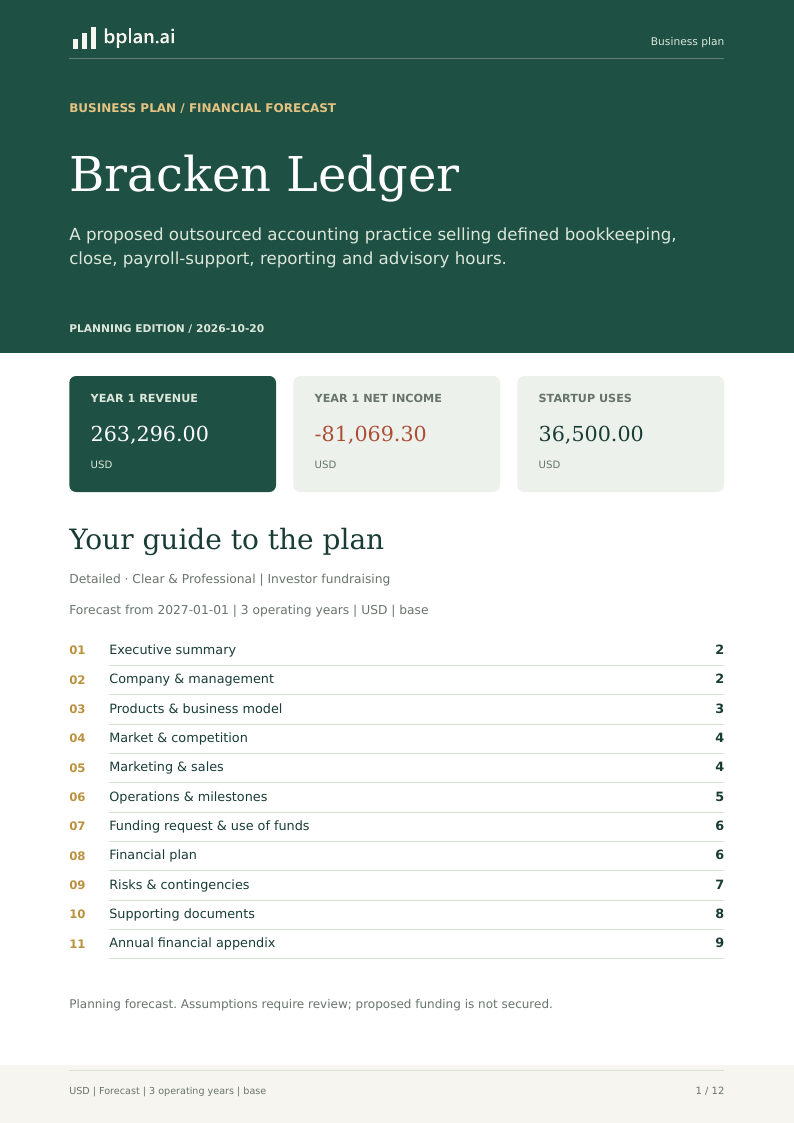
The proposal requires $225,000.00 in equity. Launch spending is $36,500.00, leaving $188,500.00 in opening cash. Year 1 revenue is $263,296.00 and net income is -$81,069.30. The first-year operating shortfall means sales do not yet cover the paid team and overhead. Funding provides time to establish demand; it does not remove that shortfall. The initial project outlay is not recovered within three operating years.
02 / THE PLAN
Company & management
Bracken Ledger will operate as an independent service business. The working owner will control scope, staffing, commercial terms and weekly cash decisions; legal formation and the ownership agreement must be completed before trading.
Company background
Bracken Ledger is a fictional Raleigh hybrid practice using a small office for controlled client work and meetings. It sells professional accounting support rather than a software subscription, payroll funds service or lending product. Actual professional eligibility and service boundaries need verification. No CPA status, audit/attest approval, filing credential or existing client book is supplied.
Ownership & management
The proposed owner contribution is $100,000.00; the remaining $125,000.00 is sought from external equity investors. The owner is also paid for an operating role. Investment valuation, ownership percentages, voting rights and distribution terms remain to be agreed.
Team & responsibilities
Two paid accountants include the owner once. Half-time bookkeeping support prepares and reconciles work for those same services, while quarter-time administration handles intake and billing. Neither creates separately sold accountant hours. Salaries and the employee allowance remain paid during gaps; actual skills, supervision and review coverage must be established. Accountants: 2 × $7,916.67 monthly, plus a 15% employer-cost allowance; Bookkeeping support: 1 × $2,291.67 monthly, plus a 15% employer-cost allowance; Administration: 1 × $1,000.00 monthly, plus a 15% employer-cost allowance. A weekly roster must cover delivery, preparation, travel, administration, leave and absence. The owner’s salary appears once in payroll; contributed time is not an additional cash contribution.
03 / THE PLAN
Products & business model
The offer is limited to work the team can define, price and deliver consistently. Each agreement should identify the buyer, included tasks, access requirements, deliverables, acceptance and payment terms.
Products & services
The five hourly categories are bookkeeping, monthly close, payroll support, management reporting and tax advisory. Bookkeeping sold from the accountant pool is not billed again from the support role. Client wages, payroll taxes, other tax remittances and held client funds are excluded from revenue. Actual professional and filing authority must be verified for each accepted service.
Pricing & revenue streams
2 paid accountants including the owner provide 320.000 scheduled hours per month (160.000 per person). Requested sold time starts at 55% of allocated capacity and follows a 3-month ramp. Five service shares total 100%; each hour is allocated once. Uniform monthly demand is assumed. Requested work grows 6% annually, subject to the available-hour ceiling; fees grow 2% annually. Staffing stays fixed. Bookkeeping: 30% of the shared capacity at $95.00 per billable hour. Monthly close: 25% of the shared capacity at $145.00 per billable hour. Payroll support: 15% of the shared capacity at $100.00 per billable hour. Reporting: 15% of the shared capacity at $165.00 per billable hour. Tax advisory: 15% of the shared capacity at $210.00 per billable hour. Fees exclude customer sales tax. Confirm scope and any exceptional materials before accepting a fixed price.
Customer value
The proposed value is an agreed close or reporting output with a clear record of client inputs, review and acceptance. No accurate-return guarantee, tax saving, audit opinion or funding approval is promised. Missing or inconsistent records require resolution with the responsible client. A completed bookkeeping task is not an attestation service or a legal opinion.
04 / THE PLAN
Market & competition
The initial market is the specific buyer and buying occasion described below. The launch should be justified by paid work in a practical service area, rather than by applying a market-share percentage to a broad industry estimate.
Target customers
Owner-led businesses with an authorized sponsor, usable financial records and a defined accounting-support need. Confirm who commissions the work, who supplies access or records and who authorizes payment. Keep the initial territory small enough to support the promised response and delivery time.
Demand & validation
Test paid scoped assignments and log record cleanup, accountant review, support preparation, revisions, invoice and collection. A recurring need for a monthly close does not prove a signed recurring client book. Tax and reporting deadlines can compete for the same accountants. Validate full effort and the quality of available records before committing the calendar.
Competition & positioning
Alternatives include an internal finance employee, another qualified practice, suitable software with internal ownership or a specialist adviser. Compare records readiness, cleanup, review, deliverables and professional boundary. No local fee ranking or tax-saving advantage is asserted. A software subscription and a professionally reviewed close are different offers.
05 / THE PLAN
Marketing & sales
The acquisition process should bring in work that fits the team and produces collected contribution after delivery costs. Track qualified opportunities, accepted quotes, completed work and cash received as separate steps.
Customer acquisition
The owner would seek relevant business introductions and describe the exact services and verified professional status. Fixed marketing/networking is separate from opening promotion. Use clearly labeled nonclient examples and protect actual financial information. Do not imply credentials, successful filings, client testimonials or a proven close-time improvement that the example lacks.
Sales process
Agree the client’s authority, records access, task boundary, responsibilities, review and payment terms. Record approved professional hours and invoice accepted work under the blended collection assumption. No customer payroll or tax balance finances the practice. Recurring work needs an explicit continuing scope rather than a duplicated monthly revenue stream.
Retention & measurement
Keep the approved scope, inputs, review trail and acceptance under appropriate access and retention arrangements. A subsequent period or amended task needs current facts and relevant authority. Separate corrections from new paid cleanup or advice. Track collected repeat work without inventing a subscribed client count or permitting promotional use of client financial records.
06 / THE PLAN
Operations & milestones
Delivery must fit the paid team’s hours, equipment and service window. Work should enter the calendar only after scope, competence, access and required resources are confirmed.
Facilities & resources
Launch assets include computers, displays, secure furniture/storage, scanning, network/security hardware and office improvements. Practice/research tools, cover, education and firm administration remain recurring costs. Contract specialist review is purchased support, not additional salaried capacity or inventory. Lease deposit and any unquoted records/tool requirements are excluded until verified. The launch asset budget is Computers and laptops: $6,000.00; Monitors and docks: $2,000.00; Office furniture and secure storage: $6,000.00; Scanner and printer: $1,500.00; Network and security equipment: $2,000.00; Office improvements: $4,000.00.
Service delivery
Qualify scope and authority, agree records readiness, schedule preparation and accountant review, resolve exceptions with the client, document acceptance and invoice. This commercial workflow is not an accounting standard, tax procedure or security certification. Delayed records consume the same professional capacity. Support work does not create an independent billable-hour pool.
Launch & development milestones
Verify professional eligibility, client terms, records controls, review/filing arrangements, insurer and premises/tool terms. Complete paid limited assignments with effort and collection logs before accepting a broad deadline calendar. Confirm the revised reserve before commitments. No credential, accepted filing, paid pilot or secured equity is presented as complete.
07 / THE PLAN
Funding request & use of funds
All proposed equity must be available before launch payments. The funding plan separates equipment and setup spending from the cash reserve needed to support operations.
Use of funds
Launch spending totals $36,500.00: $21,500.00 for assets, $15,000.00 for expensed setup and $0.00 for opening inventory. Setup covers an allowance for formation, professional preparation, training and launch work. Refundable premises deposits and additional site work are excluded until scoped quotes are available.
Sources of funding
Total proposed equity is $225,000.00, comprising $100,000.00 from the owner and $125,000.00 from external investors. Neither contribution is committed. No borrowing is included, and financing receipts are separate from earned revenue.
Owner contribution
The owner must confirm the availability and transfer date of the $100,000.00 contribution. Salary pays for the owner’s continuing operating work. The company still needs cash for payroll, equipment and supplier invoices, even when the owner contributes additional time.
Funding request
The external equity request is $125,000.00. Receiving all proposed equity leaves $188,500.00 of opening cash and a forecast funding gap of $0.00. The gap measures a cash shortfall after assumed funding; it is not a substitute for the investment request. Agree investor rights and reporting before accepting funds.
08 / THE PLAN
Financial plan
The forecast covers January 2027–December 2029 in USD, with launch spending reported separately. Its usefulness depends on the service mix, fee, staffing cost and collection terms below.
Forecast assumptions
2 paid accountants including the owner provide 320.000 scheduled hours per month (160.000 per person). Requested sold time starts at 55% of allocated capacity and follows a 3-month ramp. Five service shares total 100%; each hour is allocated once. Uniform monthly demand is assumed. Requested work grows 6% annually, subject to the available-hour ceiling; fees grow 2% annually. Staffing stays fixed. Direct costs are 2% of net fees. No product resale or purchased inventory is included. Salaries are operating expenses, outside the direct-cost ratio. Salaries and fixed overhead grow 3% annually. Collections take 26 days, supplier payments 0 days and inventory coverage 0 days. The 21% flat income-tax provision and 15% employer-cost allowance are simplified planning inputs.
Financial outlook
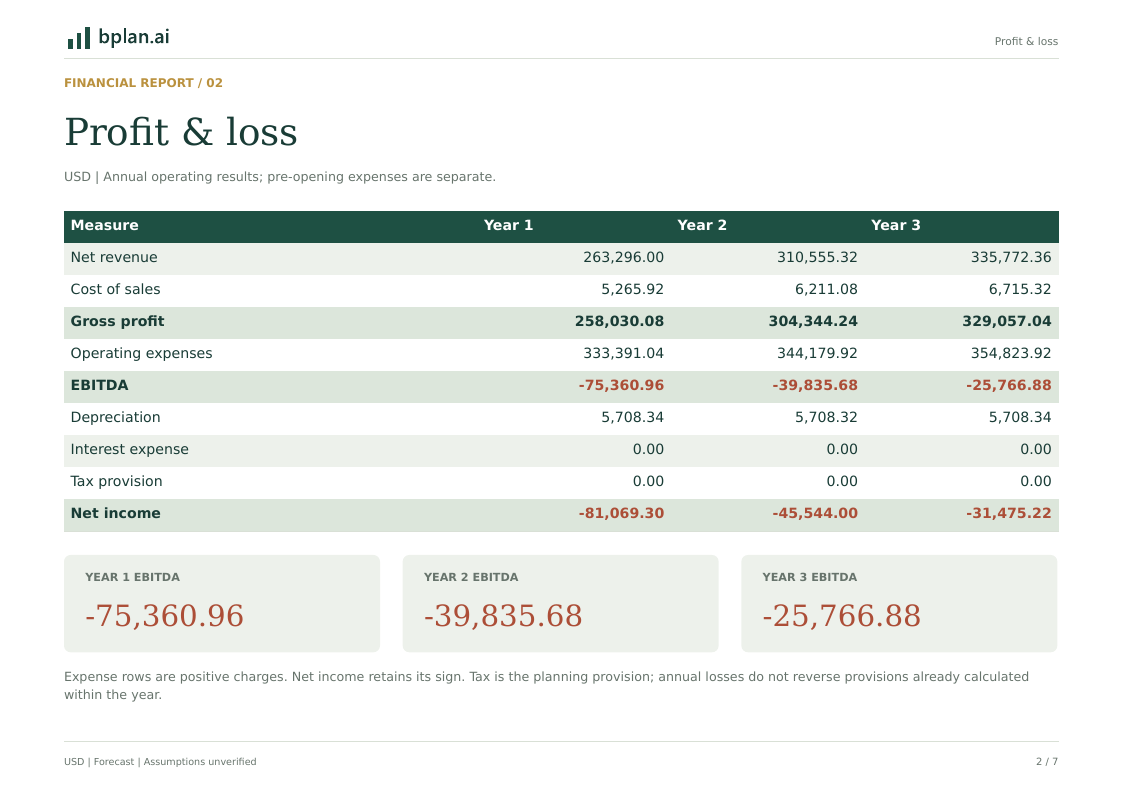
Year 1: revenue $263,296.00, EBITDA -$75,360.96, net income -$81,069.30 and closing cash $92,394.51. Year 2: revenue $310,555.32, EBITDA -$39,835.68, net income -$45,544.00 and closing cash $50,874.36. Year 3: revenue $335,772.36, EBITDA -$25,766.88, net income -$31,475.22 and closing cash $23,286.25. The first-year operating shortfall means sales do not yet cover the paid team and overhead. Funding provides time to establish demand; it does not remove that shortfall. EBITDA excludes depreciation, interest and income tax; net income includes depreciation and the tax provision.
Cash needs & financial resilience
The lowest forecast cash balance is $23,286.25, and the funding gap is $0.00. Positive monthly operating EBITDA is not reached within the three years. The initial project outlay is not recovered within three operating years. Cash differs from profit because of equipment spending, depreciation, collection delays and financing. Review the monthly low point before committing the reserve.
Debt & repayment
No debt or investor distributions are included. Any borrowing option needs an amount, draw date, interest rate and repayment schedule before its affordability can be assessed. Pre-tax project payback measures recovery of the operating investment; it is not a promised dividend, investor return or financing approval.
09 / THE PLAN
Risks & contingencies
The main exposure is committing paid resources before collected sales justify them. The owner should use the service-specific risks below to decide when to narrow the offer, defer spending or stop.
Key risks
The initial equity proposal failed the cash forecast. The explicit revised external-equity scenario increases reserve while retaining the owner contribution, all fees, workload, staffing, forecast losses and lack of payback. Poor client records, review burden, deadline peaks and slow payment can worsen cash. Additional proposed capital does not demonstrate investment merit or professional readiness.
Contingency actions
Preserve the original funding inputs and cash shortfall as the reason for revising proposed reserve. Confirm actual investor commitments and scope readiness before hiring or leasing. Test lower sold hours and longer cleanup/collection with the paid team retained. Do not add client remittances as revenue, double-bill support preparation or remove owner pay to make the case appear stronger.
10 / THE PLAN
Supporting documents
The launch decision needs commercial evidence as well as a forecast. Maintain an organized working file so that costs, commitments and delivery capacity can be reviewed before money is spent.
Available supporting information
The operating proposal defines the customer, service boundary, paid roles, launch assets and collection terms. The accompanying annual financial statements set out earnings, cash flow and the balance sheet for the three-year period. All funding remains a proposal; the business is at the prelaunch stage.
Documents to obtain
Verified professional and filing eligibility, appropriate client/records terms, review and specialist arrangements, insurer/software/lease/deposit quotes, paid effort and collection evidence and signed equity commitments remain outstanding. Entity-specific tax treatment needs actual advice. No CPA credential, audit approval, achieved tax result or secured financing is supplied. Record the actual fee, total delivery effort and date of payment for each trial assignment. Update the forecast and funding decision when quotes, commitments or measured results change a material assumption.
02 / THE FINANCIAL MODEL
How this business earns and uses cash.
2 paid accountants including the owner provide 320.000 scheduled hours per month (160.000 per person). Requested sold time starts at 55% of allocated capacity and follows a 3-month ramp. Five service shares total 100%; each hour is allocated once. Uniform monthly demand is assumed. Requested work grows 6% annually, subject to the available-hour ceiling; fees grow 2% annually. Staffing stays fixed.
The forecast covers three operating years, with prelaunch spending shown separately. Fees, workload, staffing and collection terms determine whether the business can cover its commitments and preserve cash.
| Service | Pool allocation | Base price | Billing unit |
|---|---|---|---|
| Bookkeeping | 30% | $95.00 | One sold hour |
| Monthly close | 25% | $145.00 | One sold hour |
| Payroll support | 15% | $100.00 | One sold hour |
| Reporting | 15% | $165.00 | One sold hour |
| Tax advisory | 15% | $210.00 | One sold hour |
| Cost or paid role | Base input | Treatment |
|---|---|---|
| Accountants | $15,833.34/month before employer costs | Paid role; 15% employer allowance |
| Bookkeeping support | $2,291.67/month before employer costs | Paid role; 15% employer allowance |
| Administration | $1,000.00/month before employer costs | Paid role; 15% employer allowance |
| Office rent | $1,500.00/month before employer costs | Operating expense |
| Practice and research tools | $1,500.00/month before employer costs | Operating expense |
| Professional and business cover | $350.00/month before employer costs | Operating expense |
| Marketing and networking | $600.00/month before employer costs | Operating expense |
| Utilities and communications | $250.00/month before employer costs | Operating expense |
| Firm administration services | $250.00/month before employer costs | Operating expense |
| Professional dues and education | $350.00/month before employer costs | Operating expense |
| Office supplies | $100.00/month before employer costs | Operating expense |
| Cleaning and IT support | $300.00/month before employer costs | Operating expense |
| Local travel and meetings | $150.00/month before employer costs | Operating expense |
| Payment processing | 1.5% of net fees | Operating expense |
| Client delivery and postage | 0.5% of net fees | Operating expense |
| Input | Case value |
|---|---|
| Collection delay | 26 days |
| Inventory / supplier payment | 0 days / 0 days |
| Direct costs | 2% of net fees |
| Price / requested-demand growth | 2% / 6% annually |
| Salary and fixed-cost growth | 3% annually |
| Income-tax provision | 21% simplified provision |
| Proposed owner equity | $100,000.00 |
| Proposed external equity | $125,000.00 |
| Prelaunch setup | $15,000.00 |
Direct costs cover 2% of fees and exclude the paid roles already shown in operating expenses. The selected advisory/service format has no purchased inventory. All-in customer prices are not duplicated as extra parts or product revenue.
What the forecast shows
The forecast shows a net loss in Year 1, Year 2, Year 3. Net income includes depreciation and the monthly tax provision. EBITDA excludes depreciation, interest and tax; cash also reflects assets, working capital and financing.
| Measure | Year 1 · 2027 | Year 2 · 2028 | Year 3 · 2029 |
|---|---|---|---|
| Revenue | $263,296.00 | $310,555.32 | $335,772.36 |
| Cost of sales | $5,265.92 | $6,211.08 | $6,715.32 |
| Gross profit | $258,030.08 | $304,344.24 | $329,057.04 |
| Operating expenses | $333,391.04 | $344,179.92 | $354,823.92 |
| EBITDA | -$75,360.96 | -$39,835.68 | -$25,766.88 |
| Depreciation | $5,708.34 | $5,708.32 | $5,708.34 |
| Interest | $0.00 | $0.00 | $0.00 |
| Tax provision | $0.00 | $0.00 | $0.00 |
| Net income | -$81,069.30 | -$45,544.00 | -$31,475.22 |
| Measure | Year 1 · 2027 | Year 2 · 2028 | Year 3 · 2029 |
|---|---|---|---|
| Opening cash | $188,500.00 | $92,394.51 | $50,874.36 |
| Customer collections | $242,551.47 | $308,870.85 | $333,951.13 |
| Supplier payments | $5,265.92 | $6,211.08 | $6,715.32 |
| Operating expenses paid | $333,391.04 | $344,179.92 | $354,823.92 |
| Interest paid | $0.00 | $0.00 | $0.00 |
| Tax provision paid | $0.00 | $0.00 | $0.00 |
| Operating cash flow | -$96,105.49 | -$41,520.15 | -$27,588.11 |
| Investing cash flow | $0.00 | $0.00 | $0.00 |
| Financing cash flow | $0.00 | $0.00 | $0.00 |
| Net change | -$96,105.49 | -$41,520.15 | -$27,588.11 |
| Closing cash | $92,394.51 | $50,874.36 | $23,286.25 |
| Measure | Year 1 · 2027 | Year 2 · 2028 | Year 3 · 2029 |
|---|---|---|---|
| Cash | $92,394.51 | $50,874.36 | $23,286.25 |
| Receivables | $20,744.53 | $22,429.00 | $24,250.23 |
| Inventory | $0.00 | $0.00 | $0.00 |
| Net fixed assets | $15,791.66 | $10,083.34 | $4,375.00 |
| Assets | $128,930.70 | $83,386.70 | $51,911.48 |
| Payables | $0.00 | $0.00 | $0.00 |
| Loan balance | $0.00 | $0.00 | $0.00 |
| Liabilities | $0.00 | $0.00 | $0.00 |
| Equity and retained earnings | $128,930.70 | $83,386.70 | $51,911.48 |
| Reconciliation difference | $0.00 | $0.00 | $0.00 |
Launch spending is $36,500.00; opening cash is $188,500.00 after all proposed equity. The unfunded gap is $0.00. Pre-tax project payback is not reached within 36 months. Project recovery is not an investor distribution.
Inspect the actual report
Planning limits and qualifications
Planning model, not audited accounts or tax advice. Revenue is invoiced as earned; monthly subscriptions only. Annual prepayments, refundable deposits, milestone invoices, unbilled contract assets, customer taxes, seller settlements, capitalized interest and tax-loss carryforwards are not modeled.
Collection and supplier terms use 30-day monthly interpolation. Inventory purchases and non-stock direct costs use supplier terms; operating costs, setup costs, taxes and opening stock are paid immediately. Stock coverage applies only to linked goods costs. Production stock is tracked separately at unit cost.
Fictional editorial scenario. Prices, workload, wages, costs and financing are illustrative planning inputs, not current quotes, measured local averages or actual company results.
Source first-year two-accountant practice retained for 36 months, with owner explicitly one paid accountant, half-time bookkeeping and quarter-time admin fixed. Original five shares/hourly fees remain; support creates no extra billed pool. Three-month ramp and 6% requested-hour growth replace source team expansion. Contract review is 2% purchased service without stock. No client payroll/tax remittances as revenue. Setup paid once, lease deposit excluded. Fees grow 2%, salary/fixed costs 3%; 21% tax and 15% employee allowance are simplified.
A 15% illustrative employer allowance is added to paid salaries. The flat 21% native tax provision is a simplified planning input, not an entity or personal tax opinion. Customer sales-tax receipts/remittances and owner distributions are outside this scenario.
All equity is proposed, uncommitted month-0 cash. No debt is modeled. Opening cash is a reserve, not an extra startup expense. Asset/setup/insurance/premises allowances need scoped quotes; refundable premises deposits and site-specific additional works are excluded.
03 / ACTUAL TEN-SLIDE PITCH
A focused funding conversation.
All ten pages of the delivered PDF. Buyer demand, team roles and funding remain proposed.
Bracken Ledger
Every slide is available in the complete ten-slide PDF. The full slide text follows.
Read the complete slide outline
1. Bracken Ledger
Usable records, accountable review.
Fictional prelaunch
2. Unready records take time.
Paid delivery capacity
55% sold-time target
Preparation and support also take time.
Paid work will test time and margin.
3. A clear scope. A controlled delivery process.
Agree
Schedule
Deliver
Collect
One agreed scope. Documented acceptance.
4. Start with a reachable buying occasion.
Business owners
A defined close or cleanup
Finance sponsors
An agreed reporting need
Schematic; buyers and area to validate.
5. Every service draws from one pool of hours.
Mix
Bookkeeping 30%
95/h
Monthly close 25%
145/h
Payroll support 15%
100/h
Reporting 15%
165/h
Tax advisory 15%
210/h
USD / sold hour; illustrative shared-time mix.
6. Compete on the job and the commercial terms.
Possible alternatives
Check before booking
Internal finance team
Records and authority
Another accounting firm
Professional boundary
Suitable specialist
Review and collection
Compare equivalent work and written terms.
7. Fund the launch. Keep a reserve.
225,000.00
Proposed equity
36,500.00
Launch uses
188,500.00
Opening cash
Year 1 net loss: USD -81,069.30
Minimum cash: USD 23,286.25
8. Proposed team. Clear delivery responsibilities.
Monthly base pay
Accountants
15,833.34
Bookkeeping support
2,291.67
Administration
1,000.00
The paid owner is already in the accountant team.
9. Prove the job economics before adding capacity.
Paid scope
Time
Cash margin
Prelaunch. These are the next tests.
10. Proposed external equity.
USD 125,000.00
Owner contribution: USD 100,000.00
Terms and funding remain uncommitted.
Project payback: not reached within 36 months
KEEP THE COMPLETE EXAMPLE
Three matching documents.
Free fictional sample PDFs. Actual page counts and byte sizes are shown below.
Business plan
12 pages · A4 portrait
96,446 bytes · PDF
Financial report
7 pages · A4 landscape
62,427 bytes · PDF
Pitch deck
10 pages · 16:9 landscape
46,987 bytes · PDF
Build around your own decisions.
Use your own service boundary, actual quotes, paid staffing and payment terms. Review every assumption before preparing your own package.
Create a plan like this ↗